Analysis › Drift · version 4
Estimate drift from fiducial markers – beads, or DNA origami and their binding sites – and subtract it from all localizations.
Over a long acquisition the sample drifts by tens to hundreds of nanometres, and every localization is off by however far it had moved in its frame (the RCC page says more about where drift comes from). When the sample carries fiducials – bright, still particles on the coverslip such as fluorescent beads or gold particles, seen in nearly every frame – the drift can be read off them directly: where a bead appears to move, the sample moved.
This plugin finds the beads among the localizations, follows each one through the frames, and fits one smooth drift curve to all of them. It then subtracts that curve from every localization of the file, the beads included.
Use it when the sample has beads that stay in focus over the whole acquisition, or most of it. A bead is localized to a few nanometres in every frame, so a handful of beads gives a curve that follows faster drift than COMET or RCC, which infer the drift from the overlap of blinking molecules and need thousands of them per stretch of time. Without beads, use one of those two. It needs x_nm, y_nm, frame and photons (structures, below, need no photons); with z_nm it corrects z too.
The beads are looked for in the selection: the localizations that pass the layer's filter, inside the drawn ROI (region of interest) if there is one. So an ROI drawn around the beads, or a filter that keeps only the brightest localizations, tells the plugin where to look. The selection must hold one file.
Where the beads were already picked by hand in the ROI manager – an ROI round each – markers from ROI manager takes each used ROI of the file as one bead instead of finding them; id column takes each id of an attribute, such as the bead_id a run before wrote.
DNA origami as markers. In DNA-PAINT (an imager strand binding again and again to docking strands on the target) the sample often carries DNA origami – DNA folded into a known shape with a dozen binding sites – and they sit as still as beads. Picasso's Undrift from picked (Schnitzbauer et al. 2017) uses them as drift markers. They show themselves differently from a bead, though: only while an imager is bound, a few frames every few hundred, dimly, and at a different site each time. With markers set to structures, every localization of a marker counts – no photon cut, several in a frame – each weighted by how well it is localized. Structures are not found but named: each used ROI of the ROI manager (origami picked by hand, or by Segment regions' like examples), or each id of an attribute (the binding sites Find clusters' local maxima names in cluster_id). Picasso's documentation recommends two rounds: whole origami first, then single binding sites, which the first round has made sharp enough to find (How it works, step 7). A structure needs xy_err_nm for its weights (and z_err_nm for z); without them every localization weighs alike.
1. Bright localizations. A bead gives far more photons than a dye molecule – tens of thousands, against hundreds to a few thousand. Only localizations brighter than min photons are considered.
2. Tracks. These are linked into tracks with the simple linker of Link tracks: in each frame, a localization continues the nearest track that ended within maximum jump of it. A bead can be missed in a frame, or fitted badly; a track survives up to memory frames without it (50 by default). A longer gap ends the track, and the bead's next appearance starts a new one.
3. Long tracks are beads. A track must be seen in at least min length of the frames – a quarter, by default. A dye molecule blinks for a few frames and is gone, so this is what separates the two. A bead that lands on the glass halfway through the acquisition is a bead from then on, as long as the rest of the acquisition is long enough.
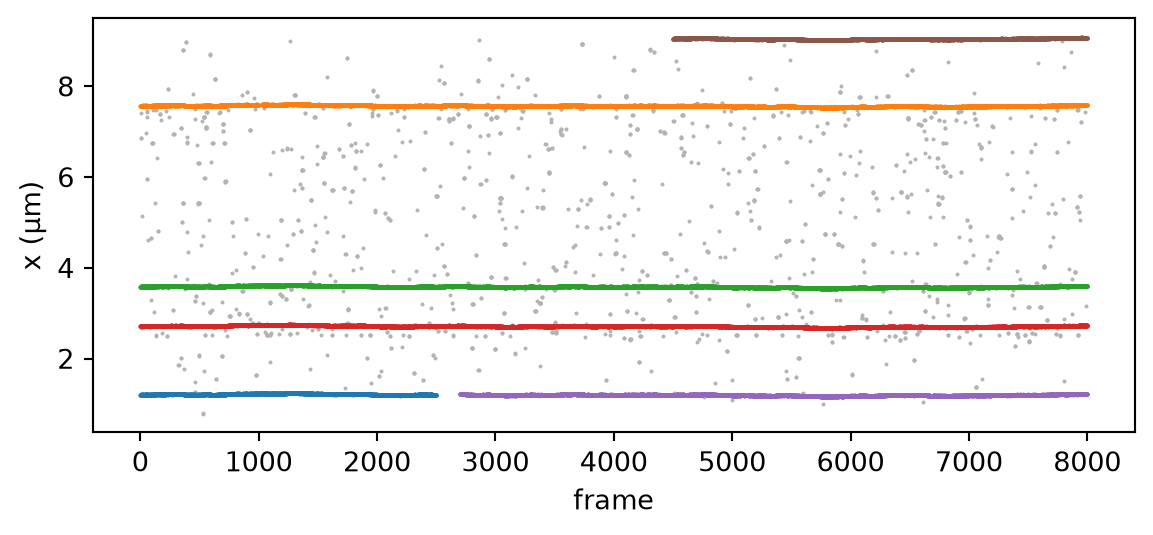
The localizations brighter than min photons (grey) and the beads found among them (coloured), x against frame: one bead is interrupted (the gap near frame 2500 is longer than the memory, so its two parts are separate tracks), one starts late.
4. One curve through all beads. Each bead sits at its own place, its offset; on top of that every bead moves by the same drift. So the position of a bead  in frame
 is modelled as

with  the bead's offset and
 the drift. The drift is a smooth curve (a cubic B-spline, the same kind of curve as COMET's), with a free value every knot spacing frames. The offsets of all beads and the curve are fitted together, by least squares, to every bead's positions at once. A frame where one bead is missing is carried by the others, and a bead that starts late adds to the curve from its first frame on. x, y and z are fitted separately.
5. Beads that disagree are left out. A bead that came loose, or a cluster of long-lived molecules taken for one, does not move with the others. Each bead is compared with the curve the other beads give, by three numbers: its noise (scatter from one frame to the next), its wander (slow motion of its own) and its jump (largest sudden step). A bead is left out when one of these is well above the other beads', and the curve is fitted again without it. The same rule judges the MBM beads of MBM drift correction. Select beads... under the settings opens the bead selector, where each bead's track can be looked at and a bead included or excluded by hand.
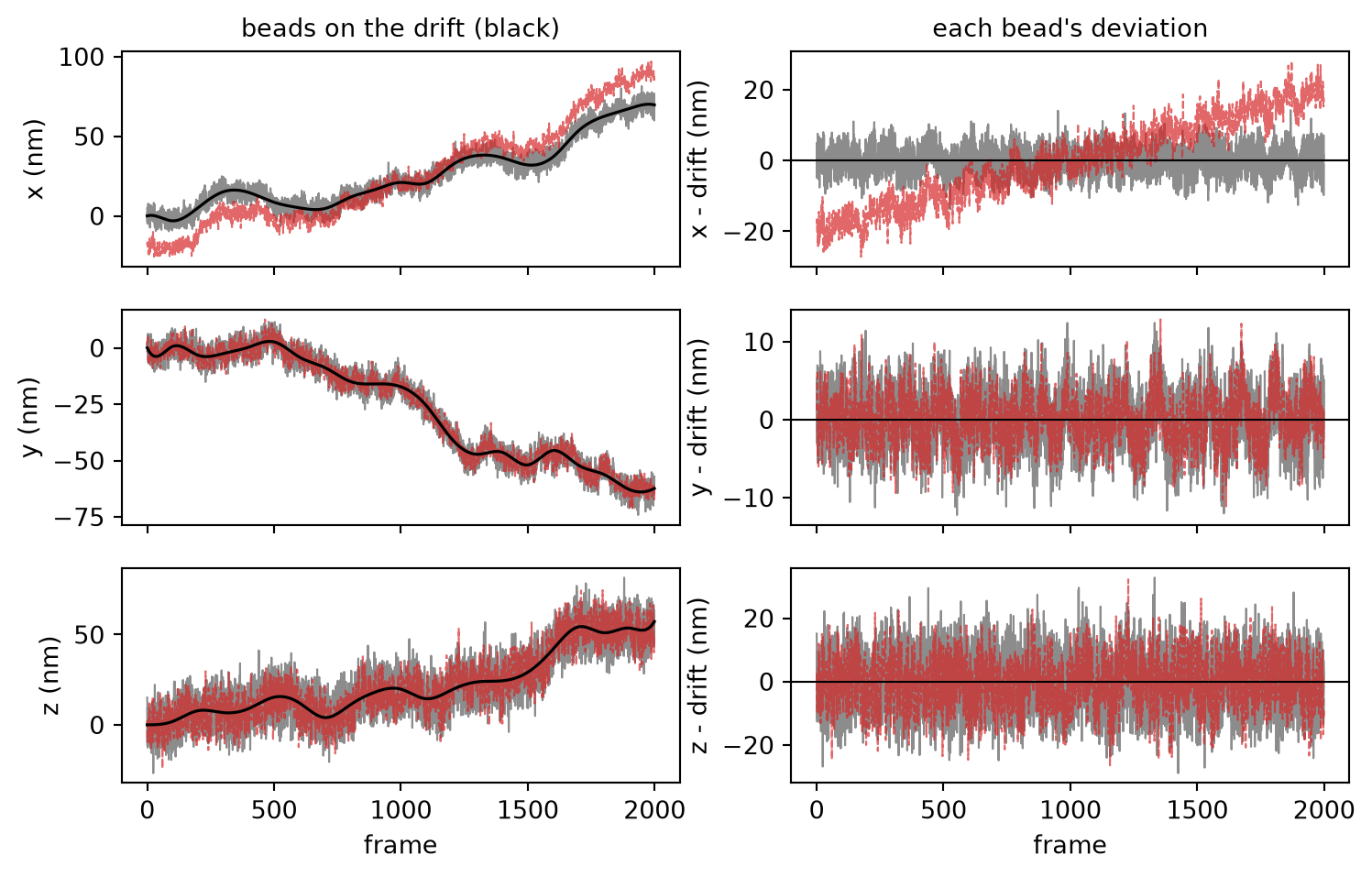
Five beads, one of which creeps 40 nm away in x over the acquisition (red, dashed): against the curve the others give (black), its deviation (right) is a slope, and it is left out.
6. Subtracted from everything. The curve is subtracted from every localization of the table: the beads, the structure, and what the filter hides.
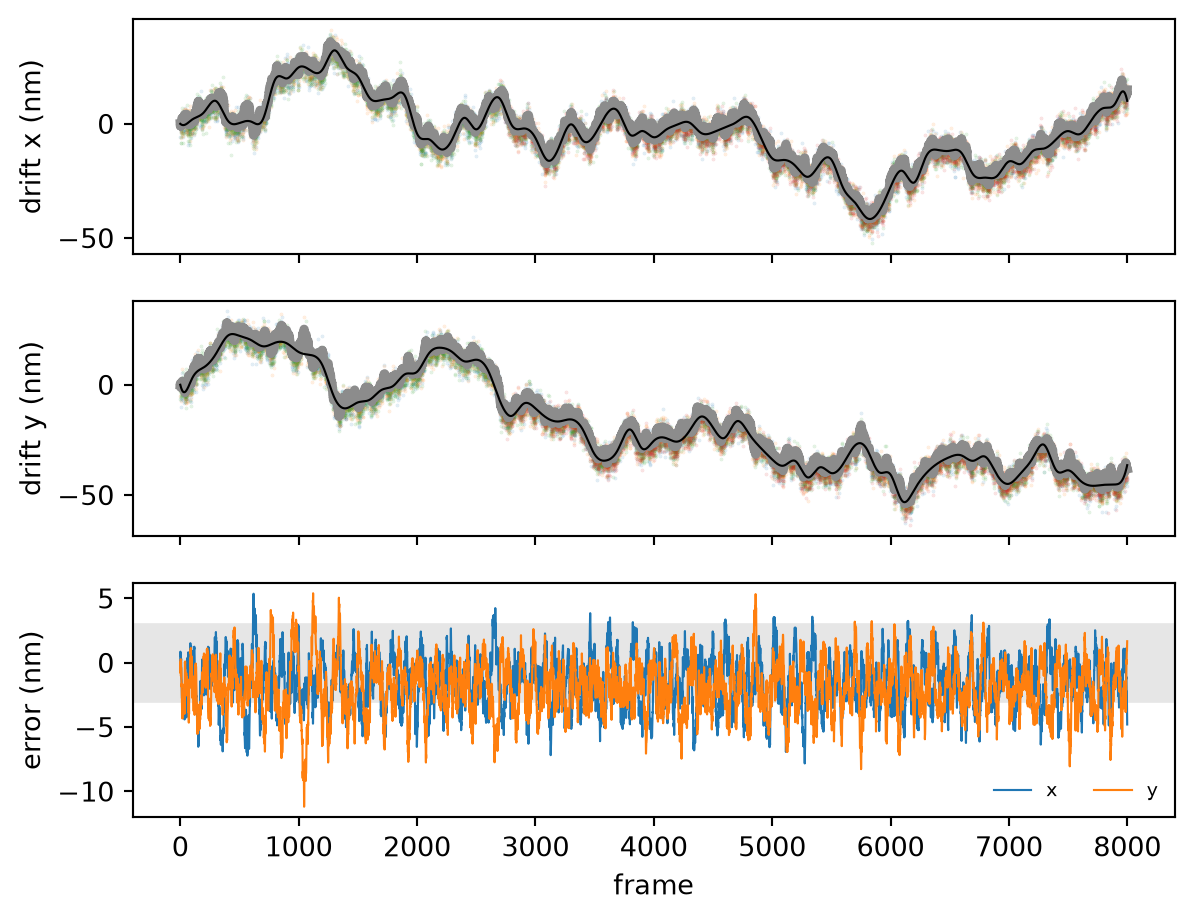
Top two: each bead's positions less its fitted offset (dots, a colour per bead) lie on one curve (black), which follows the drift that was simulated (grey, under it). Bottom: the curve less the simulated drift, about 2.5 nm rms – less than one bead's precision (3 nm, the band) – and no worse over the gaps or where the late bead joins. What is left is the frame-to-frame jitter of the simulated drift, a random walk, which a curve with a value every 100 frames does not follow.
7. Structures, in two rounds. With markers set to structures, each marker is all the localizations of its ROI or id, and the same curve is fitted through them. A structure's localizations scatter about its offset by more than their precision – by where on the origami each site sits – which the weights take into account. The first round, whole origami from the ROI manager, gives the drift to a nanometre or two. Corrected by it, the binding sites stand out as tight spots: Find clusters with local maxima names each one (cluster_id), and a second run with markers from id column on cluster_id measures what the first left. Its markers are hundreds of sites, each as sharp as its localizations, and the two curves together are good to a fraction of a nanometre. The second run corrects the table the first one corrected: the drift is the sum of the two curves.
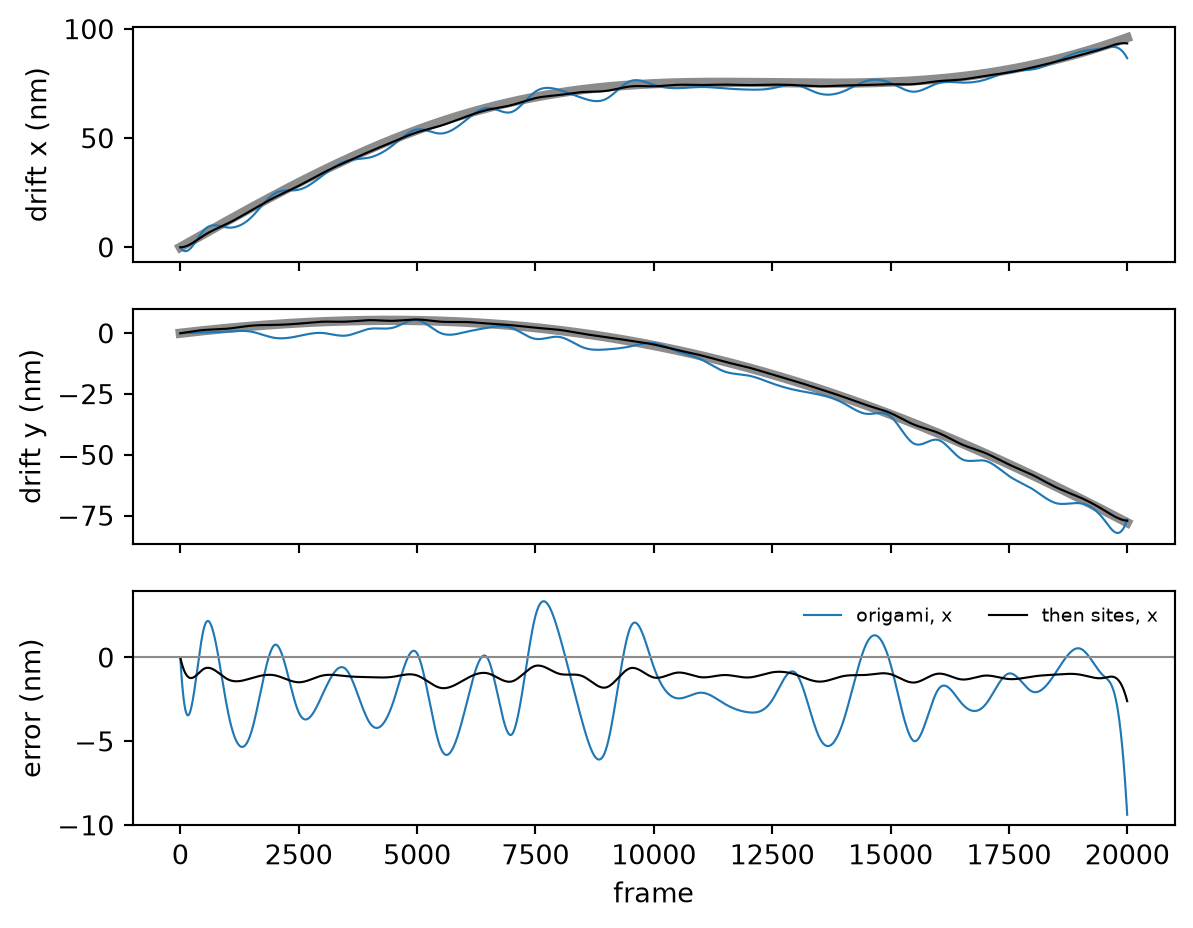
DNA-PAINT of 12-site origami (the Simulate preset "DNA-PAINT origami (20 nm grid)", 20,000 frames) with a smooth drift added (grey). Top two: the drift from the whole origami (blue) and from the binding sites after it (black). Bottom: each less the drift simulated. The origami give it to about 2 nm rms, the binding sites to 0.2 nm. The whole curve may sit a nanometre or two off the truth – its zero rests on the few localizations of the first frames, and this moves every localization alike – and it bends away at the very ends, where it has the fewest localizations to rest on.
Which table. The localizations, whatever the layer shows. The beads are found among those the layer's filter and the ROI select; the correction is applied to every localization of their file. With several files open, the others keep their positions: their frame numbers are their own, and the curve says nothing about them.
The fit. With  the cubic B-spline basis on knots evenly spaced over the frames,
 of them for
 frames,

 the knot spacing, the drift is
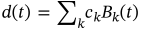 , and the offsets
 and coefficients
 minimise

the first sum over every localization  of every bead,
 its residual. The problem is linear, so it is solved in one step. Every localization of the beads used counts the same; a weighting by precision is left for later.
Which beads. Each bead's residual is taken about the fit of the other used beads, with its own offset fitted over its frames: with few beads, one inside the fit pulls the curve towards itself and hides part of its own error. From it, noise is  (the differences between consecutive points, blind to slow motion), wander
 , and jump the largest distance between the medians of the points before and after any point, over five points or a fiftieth of the bead's points, whichever is more. For each of the three, a bead is out when it exceeds the used beads' median by more than robust sigmas times their robust standard deviation (1.4826 MAD) and by more than margin. Rejecting and refitting repeat until the set of beads no longer changes, never below min beads. With every bead used, the curve is exactly the fit above.
A bead is named by its median position in micrometres (x12.3y4.5), and a choice by hand (by hand) goes to the nearest bead within 0.3 µm of that place: the linker numbers the beads in the order it meets them, and a filter or min photons changes that order. A bead whose track a gap broke in two is two beads at one place, the second named with #2.
Beads from the ROI manager. Each used ROI of the selection's file is one bead: its localizations brighter than min photons, the ROI's shape deciding which rows (the layer's filter and the drawn ROI play no part), and where a frame holds several, the brightest – a dye molecule blinking inside the ROI is the dimmer one. Nothing is linked, so min length, maximum jump and memory are greyed out. An ROI with fewer than two such localizations is no bead, and the run says which. A bead is named after its ROI (ROI 5), whose number the ROI manager never gives to another, so a choice by hand stays with it.
The reference. A constant can move from every offset into the curve without changing the fit: only how the beads moved is measured, not where the sample was. The curve is fixed by setting it to zero at the first frame,  . reference can move that zero to the last frame afterwards, by subtracting the curve's last value from all of it: for two consecutive files corrected separately, the first referenced to its last frame and the second to its first meet where they join.
The penalty. The second term keeps the system solvable where no bead was seen at all: there the curve runs straight from one side of the gap to the other. Its weight  is
 of the mean data weight per coefficient. Where beads were seen it is a slight smoothing: on the simulation above it moves the curve by a third of a nanometre on average, well below the beads' precision.
Why fit the offsets. SMAP subtracted each bead's mean position. For a bead seen in every frame that is the same thing up to a constant, but the mean of a bead that starts late is its position plus the mean drift over its frames, not over all of them, and subtracting it shifts its part of the curve by the difference. Fitting the offsets with the curve avoids that, and a bead's first point – which carries its whole localization error – is no better.
What limits the precision. With  beads each localized to
 , a stretch of
 frames sets each coefficient from about
 points, so the curve is good to roughly
 – far better than one bead's precision – as long as the drift itself is smooth on the scale of
 . What the drift does faster than that is not followed and is left in the table: in the simulation above, a random walk of 0.6 nm per frame, it is most of the 2.5 nm that remain. Faster drift wants a smaller knot spacing (50 frames brings it under 2 nm there); the Output says how to tell.
Structures. Each localization of a marker's region is a point of it (structures_in_regions); a localization in two ROIs is the later one's, and a region with fewer than two is no marker. The fit is the one above with a weight per localization and axis,
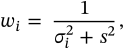
 its precision (
xy_err_nm for x and y, z_err_nm for z) and  the markers' own extent. A point of a whole origami is off the origami's centre by its precision and by where its site sits, up to 30 nm, whatever its photons: weighting by precision alone would give a bright localization of an origami many times the say of a dim one with no more to tell about the drift.
 is measured from a first fit, weighted by precision only: per marker, the mean squared residual less the mean
 , and then the median over the markers – one value for x and y, one for z. For whole origami that makes the weights nearly equal; for binding sites,
 is near zero and the weights are the precision's. One extent for all, rather than each marker its own: an origami's own extent is mostly how many of its sites were labelled and where a few stray localizations fell, and on six simulations of the preset's origami (85 in 10 µm, knots every 500 frames) each its own gave 1.9 nm rms against the truth, one for all 1.7 – the same as no weights at all, and better than precision alone (2.0). On the binding sites of the second round the precision cuts the error of no weights by a third (0.2 nm against 0.3). A precision below a third of the median is taken as that third, so one broken fit cannot carry the curve, and a missing one as the median.
What min length means for structures. Nothing, and it is not used: a binding site is seen in a few percent of the frames by design, and a marker that is seen briefly costs no more than its own offset – its few points weigh what they are worth. min photons is not used either.
Judging hundreds of markers. The structures are judged as beads are, each against the others by noise, wander and jump. With more than 20 markers each is judged against the curve of all rather than of the others: one marker of more than twenty moves the curve by about a twentieth of its error, and refitting without each costs a fit per marker and round – twenty seconds for 85 origami, where judging against all takes under one. Whole origami differ in wander by how many of their sites were labelled, and a few are left out. Among binding sites the judging matters: of the 429 sites in the figure's second round, 115 were left out for a jump or a wander, and nine in ten of those were clusters that had taken localizations of the site next to them (less than 95 % from one site, against a quarter of the sites kept), so that they move between the two as each binds. With every site used, the second round gave 0.75 nm rms instead of 0.2. A larger robust sigmas keeps more; a smaller radius in Find clusters makes fewer such mixtures.
The knot spacing for structures. The preset's origami, 85 in 10 µm, give some three localizations a frame between them, not one per bead and frame. A value every 100 frames is then set by a few hundred localizations that scatter by the origami's size: 3.8 nm rms in the first round, against 1.5 at 500 frames and 1.0 at 1000, for this smooth drift. Choosing structures sets knot spacing to 500 where it was the beads' 100 (and back).
The first frame. The curve is zero at the first frame, and its value there rests on the few localizations of the first frames. With sparse markers the whole curve can be off by a constant of a few nanometres – 2 and 3 nm in the figure's first round, 1 after the second – and the last few hundred frames bend away for the same reason. For one file that is a shift of the whole image; for consecutive files joined with reference, it is how well they meet.
Which localizations, from an id column. Each id (-1 is none) of id attribute among the localizations the selection keeps (the layer's filter and the drawn ROI, as when finding beads), named after it (cluster_id 17): the id is what the user sees of it, in its region table or as an ROI made from it, and binding sites 20 nm apart would share a name by position.
Where it departs from Picasso. Picasso's Undrift from picked (postprocess.undrift_from_fiducials, _undrift_from_picked_coordinate) takes, in each frame, each pick's localization less the pick's mean position (one a frame, the last where it has several), averages the picks with weights 1 / (each pick's mean squared deviation from that average), and interpolates linearly over the frames with none. Here every marker's offset is fitted with one smooth curve through all of them, by least squares on every localization: a frame where nothing blinked is carried by its neighbours rather than filled in afterwards; a pick's mean position is not taken as its place (it includes the mean drift over its frames, which differs between a pick seen early and one seen late); and the weight is per localization, its precision and the extent. The curve has a value every knot spacing frames rather than one per frame, so it follows slow drift better and fast drift worse.
| setting | default | what it does |
|---|---|---|
markersmarkers | beads | Beads: the brightest localization a frame, above min photons; structures (DNA origami, binding sites): every localization, weighted by its precision. beads for fluorescent beads or gold, seen in nearly every frame. structures for DNA origami and other still structures that blink: whole origami first, then their binding sites. Choices: beads; structures |
markers fromsource | find them | Find the beads as bright, long tracks; take each used ROI of the ROI manager as a marker; or each id of an attribute. find them suits nearly every file with beads. ROI manager is for the file whose beads the automatic search cannot tell from the structure – dim beads among bright clusters – and which were therefore marked by hand, and for whole DNA origami. id column takes the markers an attribute names. Structures need one of the last two. Choices: find them; ROI manager; id column |
id attributeid_column | cluster_id | Each id (-1 is none) is one marker: cluster_id from Find clusters, bead_id from a run before.
|
min photonsmin_photons | 5000 | Localizations dimmer than this are not beads. Beads only. Set it between the brightest dye localizations and the beads: the |
min lengthmin_fraction | 0.25 | A bead is seen in at least this fraction of the frames. Only for beads that are found. Lower it when beads come and go – one that lands late, or one that bleaches – and the shorter tracks are still beads. Too low, and a cluster of long-lived dye molecules could pass. 0 to 1 |
maximum jump (more)max_jump_nm | 150 nm | The farthest a bead moves between the frames it is seen in. A bead moves only by the drift between two frames it is seen in, nanometres in most acquisitions; the jump must be larger than its localization error and the drift over memory frames, and smaller than the distance between beads. at least 1 nm |
memory (more)memory | 50 frames | Frames a bead may be missing from its track. Longer bridges a bead that was out of focus for a while, as long as the drift over that time stays within maximum jump. A track broken by a longer gap is not lost if both parts are long enough. |
knot spacingspline_knot_frames | 100 frames | Frames between the spline's coefficients. 100 frames suits beads seen in every frame: a few hundred points per coefficient. Smaller follows faster drift and is noisier; larger is smoother and cuts the corners of a quick drift. For structures, which give a few localizations a frame between them, 500 to 1000 frames (In detail); more structures allow fewer. at least 5 frames |
rejection – MadRule's numbers as a part of a plugin's settings. | ||
robust sigmasrejection.k | 3 | A bead is out where its noise, wander or jump is this many robust standard deviations above the others'. Larger keeps more beads. With a handful of beads the spread is uncertain, and margin usually decides. |
marginrejection.margin_nm | 2 nm | And above the others' median by at least this. A bead is never left out for being less than this worse than the others' median. Set it about the beads' precision. |
min beadsrejection.min_beads | 2 | Never fewer beads than this. At least two are needed to tell which one moved. 1 to 100 |
by handbeads | – | Markers in or out whatever the rule says, by name: 'x12.3y4.5 out', 'ROI 5 in'; Select beads... writes it. Written by the bead selector; it can be typed too, as |
correct zuse_z | auto | Auto: if the table has z. Off corrects x and y only, for a 3D table whose z drift is corrected otherwise, or not wanted. |
reference (more)reference | as estimated | The frame the drift is zero at; first or last frame for consecutive files. Choices: as estimated; first frame; last frame |
x_nm, y_nm and z_nm (or the pixel attributes) of every localization. The beads stay in the table, corrected like everything else. The correction is recorded in the file's history and can be undone.xy_err_nm); clearly more means the curve is too stiff for the drift (a smaller knot spacing) or a bead disagrees with the others. For whole origami it is their size, some 20-30 nm; for binding sites, their localizations' precision again.bead_id (-1 for every other localization, and for a bead's localizations too dim to be linked into its track), and what the bead selector shows of each is kept as a region table ("per bead_id: Fiducials drift correction"): its name, noise_nm, wander_nm, jump_nm, coverage, n, used, its state and its offset per axis. Run on a second file, its beads are numbered after the first's.Based on SMAP's Drift/driftcorrection_beads (Ries 2020).