Analysis › Register · version 2
Put one MINFLUX measurement onto another by the MBM beads both saw:
Puts one MINFLUX measurement onto another of the same field: the second round of a sequential labelling (Exchange-PAINT, a second antibody after a wash), or two channels measured one after the other. Between the two the stage may have been moved and the sample may have settled, so the tables need not line up. The MBM beads are fixed to the coverslip and recorded in both measurements, so the map between the measurements is the map between their beads.
It reads the beads from each file's own metadata – no bead file needs to be open – finds which bead of one is which of the other, and fits the shift between them, or the shift and a rotation from three beads on. What it hands back is a named transformation that Transform applies to the target's file, as it applies what Register layers measures. Run it after any MBM drift correction: both put a measurement in the frame of its beads at its start.
1. Each bead's position in each measurement is where it was when the measurement began: a corrected measurement is in the instrument's frame at its start. Rather than its first points alone, which carry their own noise, the beads' drift (the curve MBM drift correction fits) is subtracted from all its points and the median is taken: the bead's place at the start, measured with every point.
2. Which bead is which is found from the positions, not the names: Imspector reuses its bead names and slots, and two beads 20 µm apart have had one name in two measurements of one file. Every pair of a bead of the reference and a bead of the target suggests a shift; the shift the most pairs agree on, within tolerance, is taken, and each bead is paired with the one that fits it best under that shift. A bead seen in only one measurement stays unpaired.
3. The map is a translation from one or two beads, and a rigid map – a rotation and a translation – from three or more, fitted by least squares. z, where both measurements are 3D, is shifted by the beads' mean.
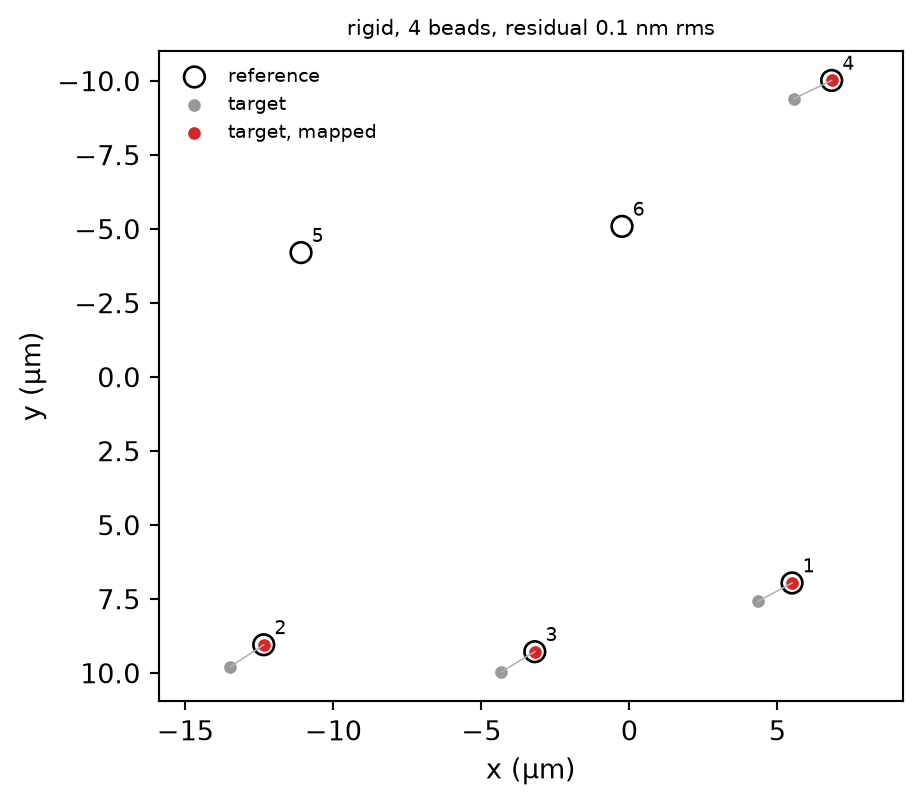
Six simulated beads in the reference (circles), four of them seen again in the target, rotated by 0.4° and shifted by 1.2 µm (grey), and mapped back (red): the pairs are found though the target saw two beads fewer, and the map puts each bead back on its partner to the beads' noise.
The rigid fit is the Kabsch (1976) solution in x and y: the rotation  and shift
 that minimise
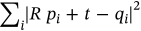 over the target's beads
 and their reference partners
 , from the singular value decomposition of the beads' cross-covariance about their centres, with the sign that excludes a mirror. No scale is fitted: the beads lie on one coverslip seen through one objective.
The frame is the one MBM drift correction corrects into, zero at the first bead point. That point carries the beads' noise, so the frame is offset by it as a constant – the same for every localization of the measurement, so the registration of two measurements corrected that way is exact. Imspector's own correction is referenced to its beads' first point too, but per bead and with its own choice of beads: for exact work run MBM drift correction on both measurements first.
Matching: every reference and target bead within largest shift of each other is a candidate; the candidate shift with the most others within tolerance of it wins, their median is the shift, and pairs within tolerance of it are taken closest first, each bead once. Beads are tens of micrometres apart and the shift a micrometre or two, so the vote is not close; were two beads closer than tolerance to each other, lower it.
The text lists each pair and its residual after the map. A residual well above the others' is a bead that moved between the measurements (or a wrong pair): it is worth re-running with fit on translation, or after removing that measurement's bad beads in MBM drift correction. Untried on real sequential measurements so far (NOTES.md).
| setting | default | what it does |
|---|---|---|
referencereference | choose... | The measurement the other is put onto. The measurement that stays where it is; every measurement with MBM beads in the open files is offered, by file and measurement. |
targettarget | choose... | The measurement that moves. The one that moves; Transform then applies the map to its file. |
fitfit | auto: rigid from three beads | A translation, or with three beads or more a rotation too. auto is right in nearly every case. Force translation when three beads lie on a line, where a rotation is poorly determined. Choices: auto: rigid from three beads; translation; rigid: rotation and translation |
tolerancetolerance_nm | 200 nm | How far two beads' shifts may differ and agree. Above the beads' scatter and the expected error of the shift, below the distance between any two beads. at least 1 nm |
largest shift (more)max_shift_nm | 5000 nm | No pair of beads further apart than this. at least 10 nm |
keep asname | – | The transformation's name; empty: target onto reference. |
The text gives the map – the beads' mean shift and, for a rigid map, the rotation – with its residual, each pair with its own residual, how many target beads found no partner, and the name the transformation is kept under. The figure shows the reference beads, the target's before and after the map, and the pairs. A good registration has residuals of a few nanometres, the beads' own noise.