Analysis › Register · version 1
Measure the shift of a target layer against a reference layer by cross-correlation – localizations as they show, or images – in x and y, optionally z, and keep it as a named transformation that Transform applies.
Measures how far one layer is shifted against another: the target against the reference. Two cameras, two halves of a chip, two colours imaged one after the other, or a widefield image and the localizations taken with it rarely sit exactly on each other, and the offset between them is easiest to read off the data itself.
Each layer can be a layer of localizations, as it shows (its filter, its files), or an image layer. The shift is found in x and y, and optionally in z (z too) for two layers of 3D localizations.
It measures and changes nothing. What it measured is kept as a named transformation of the session, under name, and the form then offers Apply with Transform: Transform opens, set to that transformation and to what the target layer shows (its file, its channel, or the image). Look at the figure first; if the peak is clear, apply.
Only a shift is measured – no rotation, no change of scale. For the full map between two cameras or halves of a chip, use Calibrate transform.
1. Two pictures on one grid. A grid of square bins (bin, 20 nm by default) is laid over both layers. Localizations are counted in its bins; an image is looked up on it, each bin taking the value of the image pixel under its centre. Each picture has its mean taken off, so a widefield image's background does not count as structure.
2. Cross-correlation. The correlation of the two pictures is computed for every shift within max shift (2500 nm by default) with Fourier transforms. It is largest at the shift that lays the target best onto the reference.
3. The peak. The highest point of the correlation, after a light smoothing, is refined below a bin by fitting a smooth curved surface (a quadratic) to the bins around it. That fit pulls towards whole bins, so the found shift is taken out of the localizations and the correlation repeated: the second peak sits near zero, where the fit is exact, and adds the small rest.
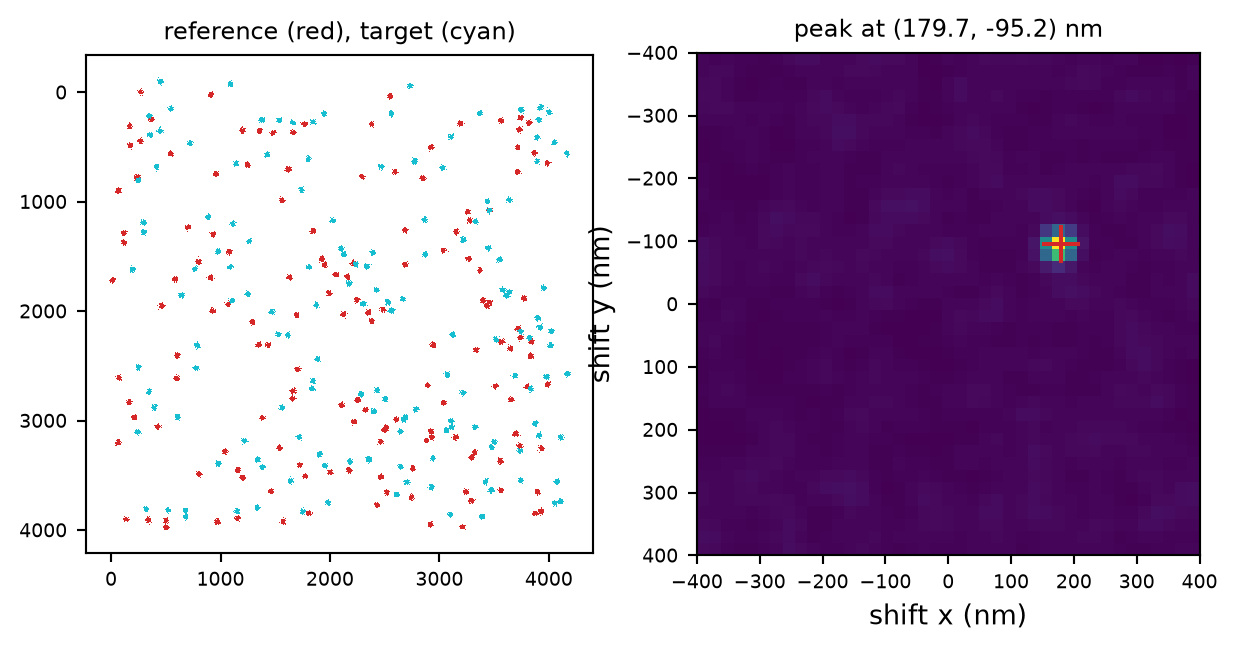
A simulated layer and a copy shifted by (180, -95) nm. Left: the two over each other. Right: their correlation, with the peak (+) at the shift.
4. z, if asked. With the lateral shift taken out of the target, the field is cut into small square tiles (200 nm), the z positions in each tile are counted in bins (z bin), and each tile's z profile of the target is correlated with the reference's. The correlations of all tiles are added and the peak, within max z shift, is the shift in z. A z profile of the whole field would mix hundreds of structures at different heights into a featureless slab; the tiles keep each profile local.
5. Kept, for Transform. The transformation that undoes the shift – the target moved by minus what was found – is kept under name. Transform applies it (Apply with Transform), to the target layer's localizations or to the image.
Which table. Each layer of localizations as it shows: merged blinks on a layer that merges them, only what its filter and its files let through. An image layer is taken as it is placed (an image moved by Transform is looked up where it now is), the plane the layer shows.
The grid spans both layers: the box around each layer's localizations, or the image's area. The search for the peak needs room around the pictures, so a grid whose bins and that room come to more than 8 million is refused, with the bin that would fit. On auto, max shift searches up to half the grid.
The correlation is that of Spatial statistics' correlation image,  with
 the reference and
 the target, each minus its mean, padded so that it does not wrap. Unlike there, it is not divided by the window's own correlation: only the position of the peak is wanted, not its height.
The peak is RCC's: the correlation within max shift smoothed by a  box to pick the bin, then a quadratic surface fitted to the unsmoothed correlation over
 bins around it, whose stationary point is the sub-bin shift. It is then refined up to three times, each time with the shift so far taken out of whichever layer is localizations and the peak looked for within 6 bins; it stops when a round moves it by less than a hundredth of a bin. On an exact shifted copy, at 20 nm bins, the first peak was up to 4 nm off and the refined one within 1 nm. Two image layers are not refined: an image is not binned again.
z is RCC's axial pass, with the reference as one time window and the target as the other: z histograms in 200 nm tiles, each minus its mean, correlated and summed, the peak fitted by a parabola over 7 bins. The zero shift is a measurement like any other here (RCC leaves it out, because in one acquisition it carries molecules on in both windows). An image has no z, so z needs two layers of localizations with z_nm.
| setting | default | what it does |
|---|---|---|
referencereference | layer 1 | The layer that stays. |
targettarget | layer 2 | The layer whose shift is measured. |
binbin_nm | 20 nm | The pixel of the pictures that are correlated. About the localization precision, or the image's pixel when one layer is an image. Much finer makes the pictures sparse and the correlation noisy; much coarser blurs the structure the peak is found from. at least 1 nm |
max shiftmax_shift_nm | 2500 nm | The farthest the peak is looked for; auto: anywhere. Above the largest offset expected. A larger range costs a larger grid and gives a false peak more room; auto searches everywhere. at least 1 nm |
z toouse_z | off | Also the shift in z; localizations with z only. Off by default: most registrations are lateral, and the z profiles need a structure with some depth. |
z bin (more)z_bin_nm | 10 nm | The bin of the z histograms. at least 0.1 nm |
max z shift (more)max_z_shift_nm | 300 nm | The farthest the z peak is looked for. Smaller than the lateral range, because a z profile is far less structured than an image and a wide range lets its maximum wander. at least 1 nm |
namename | – | What the transformation is kept as; auto: the target onto the reference. Running it again under the same name replaces what was kept. |
Ported from SMAP's (Ries 2020) XYZdisplacement, with the maximum shift of its RegisterLocs2.