Analysis › Regions · version 1
Moves every used ROI onto the centre of its localizations: a fitted
Moves every used ROI (region of interest: a shape kept in the ROI manager, inside which things are measured) so that its centre sits on the centre of the structure in it. A segmenter puts an ROI where its filter peaked, a hand where the eye landed; a measurement that assumes the structure in the middle – a radial profile, an average over many ROIs, a line through the centre – wants the ROI on it.
The centre is that of a fitted circle, by the same fit as Circle fit, for rings such as nuclear pores; or the median of the localizations, for a blob or anything not round. Run it after the ROIs are found and before they are measured, in a chain as well.
1. Each ROI's localizations. For each used ROI, the localizations inside it as the ROI manager shows them: the layer's filter (the lowest and highest values of attributes a localization must lie between), and merged blinks where the layer merges them.
2. Its centre. A circle is fitted to them (a fitted circle) and its centre taken – with the radius fitted too, or fixed at fixed radius – or the median of their x and of their y (the median).
3. The move. The ROI is moved so that its centre is there; a drawn outline and the ROI's named lines move with it. With iterations above 1 the ROI is measured again from its new place and moved again: an ROI far off its structure sees only part of it at first, and more after the first move.
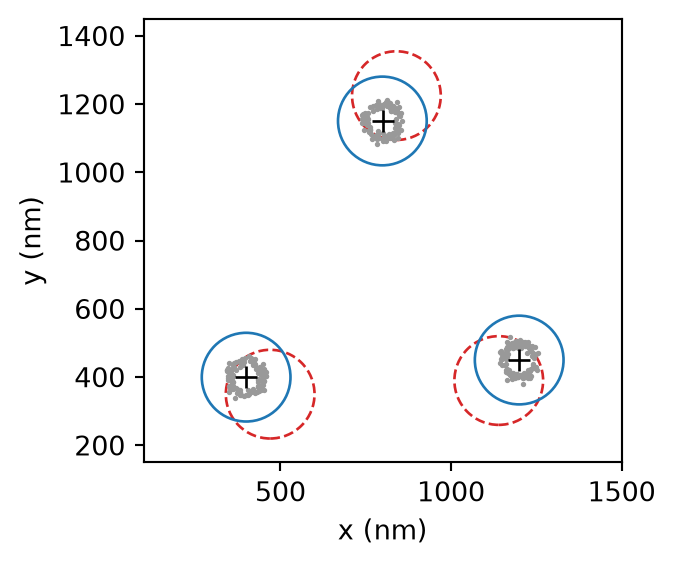
Three rings and their ROIs as a segmenter left them (dashed), off the rings' centres, and after Centre ROIs with two iterations (solid): each sits on its ring.
All the moves are one step of the ROI manager's undo (Undo). Results measured before the move describe the old place, so the per-region steps measure the moved ROIs again.
When an ROI is left where it is. An ROI without localizations, or with too few for a circle (4, or 3 with a fixed radius), is not moved; neither is one whose measured centre falls outside the ROI itself. A circle fitted to a few background localizations can land anywhere, and an ROI walked off its structure is worse than one a little off-centre. The text says how many were left.
The median is of x and of y separately. On a ring cut by the ROI's edge it is pulled towards the part inside; iterations takes it the rest of the way.
| setting | default | what it does |
|---|---|---|
centre oncentre | a fitted circle | A ring's centre is the circle's; a blob's, the median. a fitted circle for rings; it finds the centre of a ring whose localizations are all on one side of the ROI, where the median would not. the median for anything that is not a ring. Choices: a fitted circle; the median of the localizations |
fixed radiusradius_nm | 0 nm | 0: the circle's radius is fitted too. For rings of known size, such as nuclear pores (about 50 nm): the centre is then found even when only part of the ring is labelled. |
iterationsiterations | 1 | Measure and move again from the new place: an ROI far off its structure sees more of it after the first move. 1 when the ROIs are already close, 2 or 3 when a segmenter left them a third of their size or more off. 1 to 10 |
The ROIs move in the ROI manager; the line under the panel says how many moved, by how much (median and largest), and how many were left.
Ported from SMAP's evaluator CenterSites, centre all in the ROI manager (Ries 2020).