Localize · version 4 · has a preview
Fit 4Pi data: each molecule in every phase channel at once, with the IAB spline model, for x, y, the envelope's z and the interference phase.
A 4Pi microscope looks at the sample through two objectives, one on each side, and lets the two beams interfere. The camera records four images of every molecule, the phase channels. In each channel the two beams interfere at a different phase, a quarter turn apart. How the molecule's light divides between the four channels says where it is in z within one fringe period, about 260 nm. That position is several times more precise than the shape of the spot can give it.
This fitter fits each molecule in all four channels at once. It uses one model of the microscope's PSF, the IAB model of Li et al. 2020 (doi:10.1364/OL.397754). It finds x and y, and the photons of all four channels together. It also finds two answers for z, kept separate:
After the fit, 4Pi z puts the two together. It follows the slow drift of the cavity, and writes z from the phase on the fringe the envelope's z points to.
It needs a 4Pi model of the microscope, made from beads: with the PSF calibration window's 4Pi mode, or uiPSF v1's psfmodel_*_4pi.h5. The model carries each channel's PSF and how the channels map onto each other. It also needs to know where the channels are on the camera frame (channels).
It reads Hamamatsu DCIMG files, which hold the four channels side by side on one frame, and MATLAB files of qd1 to qd4, the channels already cut. A DCIMG can be fitted live, while the camera is still writing it. The frames are counted by their own records (each frame's footer, written after its pixels, holds its number), not by the file's header, which says how many there are only once the recording ends. A live fit cannot measure the channels' drift, which needs the whole acquisition. It also reads Simulate's 4Pi camera, whose model Fit this fills in.
1. The channels. Right after the file is read, the frame is cut into its channels, and from then on nothing sees the camera's frame. Detection, the fit, the registration and the drift see only the channels and the maps between them. Three things describe the channels, each kept where it belongs:
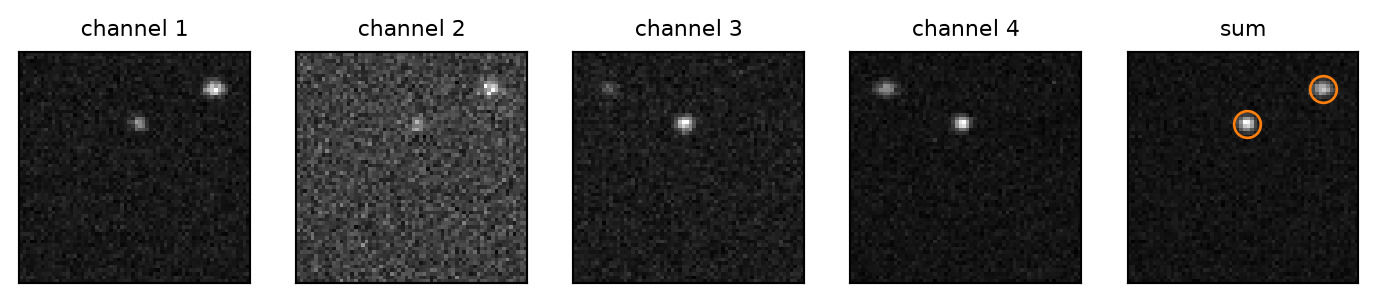
2. Finding the molecules on the sum. A molecule can be bright in one channel and nearly dark in the next: the interference moves its light between them. Summed, the four channels show the whole molecule, with no interference left. Only for this, each channel is read onto the first channel's pixels, every pixel from the channel's pixel nearest where the registration puts it, and the channels are added. The molecules are found on that sum, one peak per molecule, with detection's filter and threshold. Detection only decides where the boxes go, and the filter smooths the sum, so a pixel's alignment is enough. On a simulation with a rotated, stretched registration it found the same molecules as interpolating would, at an eighth of the cost.
One simulated frame: the four phase channels as the camera sees them, the last two mirrored, and their sum, where the molecules are found (circles). The same two molecules are bright in some channels and faint in others.
3. One fit in four channels. Each channel gets its own fit box, cut at its own pixels where the map puts the molecule. Nothing is resampled for the fit: the part of the map smaller than a pixel goes to the fitter, as in Spline 3D 2C. The fitter finds one x, y, z, photon number and phase for all four boxes, and a background for each.
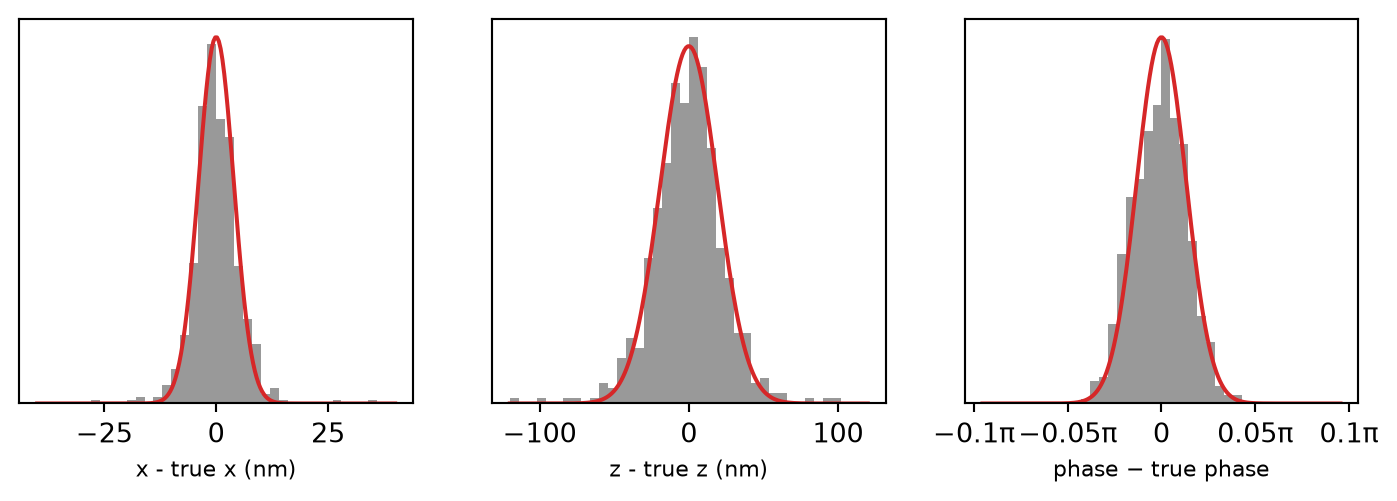
The fit of the simulation against its truth: x (left), the envelope's z (middle) and the phase (right). Each panel compares the scatter about the truth (bars) with the precision the fit reports for itself, the CRLB (line).
The model. Channel  sees

Here  is the light that does not interfere and
 ,
 the part that does, each a cubic spline in x, y and z.
 is the photon number,
 the phase and
 the channel's background.
 and
 are demodulated: the fast oscillation along z has been taken out of them and is carried by
 , so they change as slowly as the spot's shape does. Each channel's own phase offset, and its share of the light, are in its own
 ,
 and
 . An offset that is not exactly a quarter turn, or a channel with less contrast, is then simply part of the model. Bates et al. 2022 (doi:10.1038/s41592-022-01465-8) measured 5-10 nm of z bias from assuming equal channels.
Photons. The channels' models are normalised together: their  sum to one over the focal plane, so
 is the photons in all four channels. uiPSF v1 normalised to two, so its photon numbers were half; its models are renormalised when read. The photon number is one for all channels and cannot be unlinked. The phase is the way the photons divide between the channels, and a photon number for each channel would take up the interference and leave the phase undetermined.
Starting values. For a fixed z the model is linear in  ,
 and
 . So at each z plane of the model a small weighted least-squares fit over every pixel of every channel gives the phase and the photons directly, from anywhere on the circle. The planes where it fits best (z starts, two by default) are where the fit starts, and the fit with the higher likelihood is kept. On simulations with the very model that fits them, every fit found the true phase: of 20,000 molecules at the 4Pi-SMS example's photons and background, 0.01 % ended more than five errors off, with one start or with five.
On real data a fit can stop in a worse optimum where data and model disagree: a bright molecule, a model of a few beads. A second start at another phase (phase starts 2) reaches the better one. On the 4Pi-SMS example 5 % of the molecules were such fits, the phase off by about 1.5 rad and z unchanged; on uiPSF's Nup96 example 2.5 %, mostly dim. It doubles the fit's time. Neither a cheap check of the phase a quarter turn away nor a second start only for poor fits caught them at less cost. So it is a choice: one phase start for speed, two for the last few per cent. More z starts than two change almost nothing: two and three differed in 0.02 % of the molecules.
The fit. A Levenberg-Marquardt maximum-likelihood fit for Poisson noise (with an sCMOS camera's read noise, as the other fitters). x, y, z, the photons and the phase are shared by all channels. Each channel has its own background. It gives the same numbers as uiPSF v1's 4Pi fitter. On the beads v1 learned its model from, the two agree within 0.0003 pixels, 0.02 z slices and 0.001 rad. On v1's Nup96 molecules the median difference is 0.11 slices in z and 0.014 rad in phase.
The envelope's z at the end of the model. A fit that ends on the first or last plane of the model was held there. Its true z could be anywhere beyond, and its error, taken at the edge, says nothing. Such a fit gets the model's whole z range as its error, which 4Pi z then gives no weight.
The maps. A model from uiPSF v1 keeps, for each channel after the first, an affine map about the image centre. v1 read MATLAB files with rows and columns swapped. A model learned from such files is turned the right way round when it is read, its maps with it. On the Nup96 example, fitting each channel's position freely gave back the maps' offsets to within 0.06 pixels.
Registration from beads. For a model without maps, or a camera moved since the model was made, registration can be measured on beads. A bead looks different in every channel at any one z, because the interference moves its light between them. So the bead acquisition is summed over all its frames, every z step and every phase step, which leaves each channel the bead's envelope. Its centre is fitted with a Gaussian. The channels are put roughly on top of each other by the cross-correlation of these images, the beads are paired within 3 pixels, and each channel's map onto the first is the robust projective fit of Spline 3D 2C's registration. With fewer than 8 pairs it is a shift: their mean offset. A folder of bead files is pooled. On uiPSF's 26 bead scans this gave 111 pairs per channel, 0.03 pixels rms about the maps. Where the beads were, the maps were within 0.06 pixels of the ones uiPSF v1 learned with its model.
Channel drift. The channels can move against each other while the acquisition runs. A registration measured on another day can also be off, and a bead's envelope cannot show where the model's PSF of each channel is centred. channel drift measures all of these from the data before the fit. It fits drift blocks blocks of frames per block frames, spread over the acquisition, with x and y free in every channel. The median offset of each channel from where the map puts it, in each block, over the better half of the localizations, is that channel's drift there. Between blocks it is interpolated, and beyond the first and last it is held. The fit then cuts each channel's box where the map and the drift put the molecule. On the Nup96 example, with the registration from another day's beads, the channels were off by up to 1 pixel, steady to 0.1 pixels over the two files. SMAP measured this once, on the first 3000 frames.
Grouping. The phase is an angle: the mean of 3.1 and -3.1 rad is pi, not 0. Grouping a blink's localizations averages the phase as unit vectors, each weighted by its error, and combines phase_err_rad like any precision.
The phase's direction. The phase's slope in z is part of the model and kept with the table, for 4Pi z. uiPSF v1 built its bead models and its in-situ models with opposite signs; each is read with its own.
| setting | default | what it does |
|---|---|---|
| source – Where the frames come from. | ||
filesource.path | – | Any file of the acquisition: a Micro-Manager TIFF series, an NDTiff directory, one image out of a folder written one file per frame, or a simulation (*.sim.yaml, File > Simulate). |
first frame (more)source.start | 0 | Frames before this one are skipped. |
last frame (more)source.stop | auto | Auto: to the end. at least 1 |
livesource.live | off | The file is still being written: fit what is there and keep watching for new frames. |
stop after (more)source.live_timeout | 30 s idle | Live: give up after this long without a new frame. at least 1 s idle |
frames per block (more)source.chunk | 200 | Frames read and detected at once; only memory and speed depend on it. at least 1 |
microscope – The microscope and its camera: ADU -> photons and pixel -> nm. Empty fields come from the file, the camera database and the microscope database; shown as one line and a window (gui.microscope_form), the values locked until unlocked. | ||
microscopecamera.microscope | auto | Auto: recognised from the file's metadata, else the last one used. |
cameracamera.camera | auto | Auto: identified from the file's metadata, else the microscope's. |
conversioncamera.conversion | auto | Photoelectrons per count; auto: from the file or the camera database. |
offsetcamera.offset | auto | The count of a pixel that saw no light. |
EM gain oncamera.em_on | auto | An EMCCD with its electron multiplication on: the counts are divided by the gain, and the noise is doubled. |
EM gaincamera.emgain | auto | The EM gain the camera was set to. |
pixel sizecamera.pixelsize_um | auto | The pixel's size in the sample, after the magnification. |
pixel size ycamera.pixelsize_y_um | auto | Auto: square pixels, the same as in x, or the microscope's. |
read noisecamera.read_noise_e | auto | Rms per pixel; auto: the camera's, else 1 (an sCMOS). |
channels – Where a 4Pi's phase channels are on the chip: the channels part of Spline 4Pi and of the PSF calibration window's 4Pi beads, one part so that the two read a chip alike (fourpi_layout). The maps between the channels are not here: they are the model's, learnt with the PSF. | ||
layoutchannels.layout | the file's, else the microscope's | Where the phase channels are: the file's own layout, the microscope's (the database), typed, or the 4Pi-SMS design. auto takes the file's own layout where it has one: MATLAB quadrant files put the channels side by side. Otherwise it takes the microscope's: in its entry of the microscope database, each channel can have a |
x cornerschannels.x_corners | 0, 200, 400, 600 | Each channel's left edge on the chip, comma-separated. |
y cornerschannels.y_corners | 0, 0, 0, 0 | Each channel's top edge on the chip. |
widthchannels.width | 200 px | One channel's width. at least 8 px |
heightchannels.height | 200 px | One channel's height. at least 8 px |
mirrored in xchannels.mirrored | – | The channels mirrored left-right, by number from 1, comma-separated; empty: none. |
| detection – Finding candidates in the filtered image. | ||
filterdetection.filter | difference of Gaussians | What the frame is smoothed with before maxima are looked for; the difference of Gaussians also removes a smooth background. Choices: difference of Gaussians; Gaussian |
filter sigmadetection.sigma | 1.2 px | The width of the smoothing: about the PSF's. at least 0.1 px |
cutoffdetection.cutoff_mode | dynamic (x noise) | Dynamic: set per frame from the noise of the filtered image; absolute: a fixed value. Choices: dynamic (x noise); absolute (photons) |
cutoff valuedetection.cutoff | 1.7 | Lower finds dimmer molecules, and more noise. |
| fit region – Where in the frame to fit: shapes drawn on the preview's frame. | ||
drawnregion.shapes | Drawn on the Preview's frame: candidates outside the include shapes, or inside an exclude shape, are not fitted. | |
use the regionregion.use | on | Off fits the whole frame and keeps the shapes. |
| model | ||
4Pi modelmodel.calibration | – | A 4Pi model (.h5): this program's or uiPSF v1's. A 4Pi model made from beads of the same microscope, with the dye's filter. uiPSF v1's bead model ( |
link x, ymodel.link_xy | on | One position for every channel; off measures each channel's own, to check the registration. Unlinked, each channel gets its own x and y. The table then has, for each channel, how far its position is from where the map puts it ( |
z starts (more)model.starts | 2 | How many z planes of the phasor start are fitted from. 1 to 6 |
phase starts (more)model.phase_starts | 1 | From each z start, how many phases around the circle; 2 catches the few fits that stop in a worse optimum, at half the speed. 1 by default. 2 for the final localizations of a measurement, where 2-5 % of the molecules otherwise keep a phase about 1.5 rad off, 70 nm in z from the phase. 1 to 4 |
channel driftmodel.channel_drift | off | Measure how the channels move against each other, from fits with x and y free per channel, and follow it. It costs a second fit of drift blocks × frames per block frames, 5000 by default. Worth it for every long acquisition, and whenever the registration was not measured on the same day. Each fit's offsets are weighed by its error and those that are no pair left out; with over time (the default) they make a smooth curve over the acquisition, as the two-colour fitters' channel move does, else one offset per channel. The run draws each channel's offsets and the curve in a tab of its own. |
drift blocks (more)model.drift_blocks | 10 | How many blocks of frames, spread over the acquisition, the drift is measured in. at least 1 |
frames per block (more)model.drift_frames | 500 frames | How many frames each block fits. at least 10 frames |
over timemodel.drift_over_time | on | Follow the drift over the acquisition as a smooth curve; off: one offset per channel for the whole acquisition. |
| registration – How the channels map onto the first: the maps kept with the model, measured on beads, a saved registration, or none. | ||
frommodel.registration.source | the model's | The maps kept with the model, measured on beads, a saved registration, or none. Use the model's: the PSF of each channel was learned centred where its map puts the molecule, so the two belong together. from beads is for a model without maps, or after the camera has moved. Tick channel drift with it, which also corrects the part of the registration that beads cannot see. none is for channels that were registered before they were saved. Choices: the model's; from beads; from a registration file; none |
beadsmodel.registration.beads | – | A bead acquisition in this layout (a z stack), or a folder of them; measured once, kept beside them. A bead z stack taken in the same layout: a DCIMG file or series, a quadrant |
registration filemodel.registration.path | – | A channel registration (.json), as beads leave beside them. A registration that beads left, used for another acquisition. It is readable as text: each channel's map is also given as its shift at the channel's centre, its scale and its rotation. |
| fit – Everything about the fit that is not the camera or the PSF model. | ||
fit boxfit.roisize | 13 px | The square cut around each candidate and fitted. at least 5 px |
iterations (more)fit.iterations | 50 | The most steps a fit may take. at least 1 |
max fit distance (more)fit.max_fit_distance | auto | Reject fits that ran off; auto: keep all. |
per-pixel noise (more)fit.per_pixel_noise | off | An sCMOS's offset and read noise pixel by pixel, from the camera's noise map. Each phase channel's pixels weighted by their own read noise, from the camera's noise map (Camera noise calibration), cut into the four channels as the frames are. The map must cover all four rectangles; record the dark frames with the camera ROI of the data, or the whole chip. |
| output | ||
save HDF5output.save | on | Write the table to a file as it is fitted. |
fileoutput.path | – | Filled from the source: <acquisition>_locs.hdf5 next to the folder the images are in. |
raw frames (more)output.raw_frames | 50 | Camera frames kept with the table, in photons, after their average; 0: none. |
show image tags (more)output.show_tags | PIZStage | Image tags drawn while the fit runs and when it is done, names or parts of names; empty: none (Analysis/Process/Image Tags). |
| after the fit – The steps in the order they run; each step's settings follow its switch. | ||
astigmatic zfinish.astigmatic_z | off | Z from the widths of the elliptical Gaussian, before any drift correction so that it can correct z (Analysis/After fit/Astigmatic z). |
| z calibration | ||
calibrationfinish.astigmatic.calibration | from a file | A file from the PSF calibration window (elliptical Gaussian), or the curves typed. Choices: from a file; typed |
filefinish.astigmatic.path | – | An astigmatic z calibration (.h5). |
| curves – One curve per axis, s(z) = s0 sqrt(1 + u^2 + A u^3 + B u^4), u = (z - focus) / depth. | ||
width xfinish.astigmatic.typed.sigma_x_nm | 130 nm | s0: the narrowest the spot gets in x. at least 1 nm |
focus xfinish.astigmatic.typed.focus_x_nm | 300 nm | The z where x is narrowest; z = 0 is the round spot. |
depth xfinish.astigmatic.typed.depth_x_nm | 400 nm | How far from its focus the x width has grown by sqrt(2). at least 1 nm |
width yfinish.astigmatic.typed.sigma_y_nm | 130 nm | s0: the narrowest the spot gets in y. at least 1 nm |
focus yfinish.astigmatic.typed.focus_y_nm | -300 nm | The z where y is narrowest. |
depth yfinish.astigmatic.typed.depth_y_nm | 400 nm | How far from its focus the y width has grown by sqrt(2). at least 1 nm |
A x (more)finish.astigmatic.typed.a_x | 0 | Huang's cubic term in x. |
B x (more)finish.astigmatic.typed.b_x | 0 | Huang's quartic term in x. |
A y (more)finish.astigmatic.typed.a_y | 0 | Huang's cubic term in y. |
B y (more)finish.astigmatic.typed.b_y | 0 | Huang's quartic term in y. |
z rangefinish.astigmatic.typed.z_range_nm | 800 nm | +- this: where the curves are trusted. at least 10 nm |
z scalefinish.astigmatic.z_scale | 1 | True z per apparent z: about 0.7-0.8 for an oil objective imaging in water, 1 for none. at least 0.01 |
4Pi zfinish.fourpi_z | on | Z from the interference phase of a 4Pi fit, unwrapped by its envelope z (Analysis/After fit/4Pi z). |
| 4Pi phase | ||
calibrationfinish.fourpi.slope | as fitted | The phase's slope in z: kept with the table by the 4Pi fit, or read from a 4Pi model file. Choices: as fitted; from a model file |
modelfinish.fourpi.path | – | A 4Pi model (.h5): this program's or uiPSF v1's. |
time windowfinish.fourpi.window_frames | 1000 frames | The cavity's phase is measured over this many frames. at least 10 frames |
smoothingfinish.fourpi.smoothing | 1 windows | Average each window with its neighbours, this many in all. at least 1 windows |
refine periodfinish.fourpi.refine_period | off | Find the fringe period that the data agree with best. |
z scale (more)finish.fourpi.z_scale | 1 | True z per apparent z: 1 when sample and immersion index match. at least 0.01 |
overlay channelsfinish.overlay | off | Move the second half of a two-channel fit onto the first, by beads; channel is the half (Analysis/After fit/Overlay channels). |
| channel overlay | ||
transformation fromfinish.overlay_channels.source | transformation file | A saved registration, beads already fitted as two channels, or bead movies to fit. Choices: transformation file; fitted beads; bead movies |
filefinish.overlay_channels.path | – | A _2ct.h5 (Calibrate transform, or this plugin's), or a dual-colour bead calibration. |
fitted beadsfinish.overlay_channels.beads_table | – | Bead localizations fitted with channels > read: two channels. |
bead moviesfinish.overlay_channels.beads | – | A folder of bead movies, or one movie's path; beads seen in both halves. |
| bead fit – How the bead movies are fitted: Gaussian 2D, two channels, the sample's camera. | ||
cutofffinish.overlay_channels.bead_fit.cutoff | 1.7 | The detection threshold, in units of the filtered frame's noise (the fitters' dynamic cutoff). at least 0.1 |
at mostfinish.overlay_channels.bead_fit.max_frames | auto | Frames fitted per bead movie; auto: all. at least 1 frames |
| channels – Where a split chip's two channels lie: the microscope's entry, or chosen by hand. | ||
layoutfinish.overlay_channels.channels.layout | the microscope's | How the chip is split: the microscope's entry, or chosen by hand with the main channel and the split. Choices: the microscope's; right-left; right-left mirrored; up-down; up-down mirrored |
main channelfinish.overlay_channels.channels.main_channel | the microscope's | The channel the other is registered onto: the microscope's (its transmitted arm), or either half, to swap them. Choices: the microscope's; left; right; upper; lower |
split position (more)finish.overlay_channels.channels.split_position | auto | The first pixel of the second channel, on the chip, for a layout chosen by hand; empty: the middle of the frame. at least 1 px |
| registration – How a registration between two channels is measured: the vote, the pairing and the fit. | ||
transformationfinish.overlay_channels.registration.model | projective (8 coefficients) | Projective extrapolates gracefully; the polynomial describes a distorted field far better where the pairs reach, and is refused when they do not reach far enough. Choices: projective (8 coefficients); polynomial, order 3 (20) |
vote bin (more)finish.overlay_channels.registration.vote_bin_px | 2 px | The bin of the histogram of pair vectors the offset is voted in. at least 0.1 px |
vote smoothing (more)finish.overlay_channels.registration.vote_smooth_px | 4 px | The width of the difference-of-Gaussians filter the vote is scored with. at least 0.1 px |
coarse matchingfinish.overlay_channels.registration.coarse_tolerance_px | 20 px | First pass; must cover the rotation between the channels – 3 degrees over 512 px is 27 px. at least 0.1 px |
fine matchingfinish.overlay_channels.registration.fine_tolerance_px | 1 px | Second pass over clean matches only, which is where the accuracy comes from; 0 skips it. |
adapt fine matching (more)finish.overlay_channels.registration.adapt_fine_tolerance | on | Widen the fine matching to what the coarse fit misses its own pairs by, when those pairs are clean. |
minimum pairs (more)finish.overlay_channels.registration.min_pairs | 20 | Fewer pairs than this and the registration refuses. at least 4 |
pairs used in the fit (more)finish.overlay_channels.registration.max_pairs | 20000 | At most this many pairs, drawn at random, go into each fit. at least 4 |
outlier threshold (more)finish.overlay_channels.registration.reprojection_threshold_px | 1 px | The robust (RANSAC) fit's inlier radius, at least; it widens with the matching tolerance. at least 0.01 px |
dx/dy limit (more)finish.overlay_channels.registration.transform_axis_limit_px | 0.5 px | The largest |dx| or |dy| a pair may keep after the first fit, at least; it widens with the matching tolerance. at least 0.01 px |
keep the registrationfinish.overlay_channels.save | on | Write it beside the beads as <name>_2ct.h5 and use it again while the beads and these settings are unchanged. |
drift correctionfinish.drift | none | Estimate the drift from the finished table and subtract it from every localization. Off by default: it is minutes of work on a dataset it cannot see beforehand. Choices: none; RCC; COMET |
| RCC drift – How finely to bin, render and search. | ||
time windowsfinish.rcc.n_timepoints | 20 | How many windows the acquisition is cut into: more follow faster drift, fewer are less noisy. at least 2 |
pixel sizefinish.rcc.pixelsize_nm | 15 nm | The pixel of the images that are correlated; about the localization precision. at least 1 nm |
z bin (more)finish.rcc.z_pixelsize_nm | 5 nm | The bin width of the z histograms. at least 0.1 nm |
max driftfinish.rcc.max_drift_nm | 500 nm | The largest drift between any two windows that can be found. at least 1 nm |
peak fit half-width (more)finish.rcc.fit_window | 3 px | The patch the correlation peak is fitted over, for its sub-pixel position. at least 1 px |
max image size (more)finish.rcc.max_pixels | 2048 px | A wider field of view is folded back onto itself, to keep the correlation fast. at least 64 px |
correct zfinish.rcc.use_z | auto | Auto: if the table has z. |
merge blinksfinish.rcc.group | on | Merge the localizations of one blink into one before measuring. |
within (more)finish.rcc.group_dx_nm | auto | How close localizations in consecutive frames must be to be one blink; auto: the session's merge settings. |
dark frames (more)finish.rcc.group_dt | auto | How many dark frames a blink may skip; auto: the session's merge settings. |
tile (more)finish.rcc.tile_nm | 200 nm | The axial pass correlates z histograms in tiles of the field of view this size. at least 1 nm |
tile y (more)finish.rcc.tile_y_nm | auto | Auto: square tiles. at least 1 nm |
max axial drift (more)finish.rcc.axial_max_drift_nm | 200 nm | How far from zero the axial correlation peak is looked for. at least 1 nm |
skip zero shift (more)finish.rcc.exclude_zero_lag | on | Leave the zero-shift sample out of the axial peak search. |
error barfinish.rcc.split_half | on | Estimate again from each half of the field and show both: how far they differ is twice the curve's noise. |
reference (more)finish.rcc.reference | as estimated | The frame the drift is zero at; first or last frame for consecutive files. Choices: as estimated; first frame; last frame |
| COMET drift – COMET parameters. The defaults suit a typical SMLM movie. | ||
window unit (more)finish.comet.segmentation_mode | frames | What window size counts; time-window fit only. Choices: frames; localizations; windows |
window sizefinish.comet.segmentation_var | 500 | Frames or localizations per time window, or the number of windows; time-window fit only. at least 1 |
max driftfinish.comet.max_drift_nm | 300 nm | The largest drift expected; also the radius within which localizations are paired. at least 1 nm |
target sigmafinish.comet.target_sigma_nm | 30 nm | The finest width of the overlap Gaussian, where refinement stops. at least 0.1 nm |
initial sigma (more)finish.comet.initial_sigma_nm | auto | The width the refinement starts from; auto: a third of max drift. |
smoothing (more)finish.comet.boxcar_width | 1 windows | Running mean over this many windows between refinement steps; 1 is none; time-window fit only. 1 to 1000 windows |
interpolation (more)finish.comet.interpolation | cubic | The curve from the window estimates to every frame; time-window fit only. Choices: cubic; catmull-rom |
max locs / window (more)finish.comet.max_locs_per_segment | auto | A random subset of at most this many per window; auto: all; time-window fit only. at least 1 |
ftol (more)finish.comet.optimizer_ftol | 1e-07 | Relative change of the cost at which the optimizer stops. |
approximate kernel (more)finish.comet.approximate_kernel | on | Skip pairs more than 6 sigma apart; the spline fit always does. |
ftol coarse (more)finish.comet.optimizer_ftol_coarse | auto | Ftol for the steps above the target sigma; auto: ftol; time-window fit only. |
quality control (more)finish.comet.quality_control | off | Discard time windows whose fit does not beat no correction; needs fit spline off. |
min lift (more)finish.comet.min_lift | 0 | How much a window's fit must improve its overlap over no correction to be kept. |
merge blinksfinish.comet.group | on | Merge the localizations of one blink into one before estimating. |
within (more)finish.comet.group_dx_nm | auto | How close localizations in consecutive frames must be to be merged; auto: the session's merge settings. |
dark frames (more)finish.comet.group_dt | auto | How many dark frames a blink may skip; auto: the session's merge settings. |
two stage (more)finish.comet.two_stage | off | A grouped pass, then an ungrouped one within fine radius. |
fine radius (more)finish.comet.two_stage_radius_nm | 30 nm | The max drift of the second, ungrouped pass. |
RCC first (more)finish.comet.rcc_prepass | off | Correlate rendered time windows to take out the bulk of the drift, then run COMET over a small max drift. |
RCC windows (more)finish.comet.rcc_prepass_windows | 10 | The time windows RCC correlates. at least 2 |
RCC max drift (more)finish.comet.rcc_prepass_max_drift_nm | auto | Auto: RCC's own default. |
fit splinefinish.comet.spline | on | Fit the drift as a smooth curve in time rather than one value per time window. |
knot spacingfinish.comet.spline_knot_frames | 2000 frames | Frames between the spline's coefficients. at least 10 frames |
spline penalty (more)finish.comet.spline_penalty | 0 | Extra penalty on the curve's bending; 0 is none. |
transformationfinish.comet.transformation | shift | What changes over time besides the position; spline fit only. Choices: shift; xy scale; xy scale + rotation; xy affine; xy affine + z scale; 3D affine |
transformation knots (more)finish.comet.transformation_knot_frames | auto | Frames between the transformation's spline coefficients; auto: the knot spacing. at least 10 frames |
transformation penalty (more)finish.comet.transformation_penalty | 0 | Pulls the transformation towards none where the data say little; 0 is none. |
correct zfinish.comet.use_z | auto | Auto: if the table has z. |
precision weightsfinish.comet.precision_weights | on | Widen each pair's Gaussian by the two localizations' precisions, so imprecise ones count less; needs xy_err_nm, and z_err_nm for z. |
z width (more)finish.comet.sigma_z_factor | 1 x lateral | The overlap Gaussian's width in z as a multiple of its lateral width; 1 is one width for all axes. 0.1 to 20 x lateral |
error barfinish.comet.split_half | on | Estimate again from each half of the field and show both: how far they differ is twice the curve's noise. |
reference (more)finish.comet.reference | as estimated | The frame the drift is zero at; first or last frame for consecutive files. Choices: as estimated; first frame; last frame |
assign coloursfinish.assign_colors | on | Split the localizations by their photon ratio and write channel (Analysis/After fit/Assign colours). |
| colour assignment | ||
methodfinish.colors.mode | split at the minima | A cut in r, or a posterior per localization. Choices: split at the minima; probabilistic |
coloursfinish.colors.colors | 2 | How many species the histogram of r holds. 1 to 6 |
exclusion drfinish.colors.exclusion | 0.05 | Minima: leave this much of r on either side of a boundary unassigned. |
sigmafinish.colors.tolerance | 3 | Probabilistic: a colour is given only within this many sigma of its expected split, the sigma being that localization's own photon statistics plus any extra spread. 0: assign to the nearest colour however far away. |
keep the tailsfinish.colors.keep_tails | off | Probabilistic: apply the sigma test only between the outermost colours, so a localization more extreme than the first or the last mode is kept rather than refused. |
allowed crosstalkfinish.colors.crosstalk | 0.05 | Probabilistic: refuse what is too close to call as well – the largest expected fraction of wrongly assigned localizations. Narrow beside the sigma test, and what matters where two colours overlap. 1e-06 to 0.5 |
extra spreadfinish.colors.spread | 0 | Probabilistic: a species' own width in r, added in quadrature to the shot noise, for a dye whose splitting ratio varies across the field or between molecules. 0: shot noise alone (the summary prints what the modes suggest). |
use fitted errorsfinish.colors.use_errors | on | Take the photon errors from the fit where the table has them; otherwise sqrt(photons). |
use abundances (more)finish.colors.use_prior | on | Probabilistic: weight each species by how much of the sample sits under its mode. |
minimum photons (more)finish.colors.min_photons | 0 | Localizations with fewer photons in total are ignored and left unassigned. |
intensity LUT (more)finish.colors.cmap | viridis | The colour map of the intensity plot's 2D histogram. Choices: viridis; cividis; turbo; magma; inferno; Greys; Greys_r |
histogram bins (more)finish.colors.bins | 200 | How many bins the histogram of r has over its whole range, -1 to 1. 10 to 2000 |
smoothing (more)finish.colors.smoothing | 2 bins | The histogram is smoothed by this much before its maxima are looked for; it also sets how far apart two modes must be. |
expected r (more)finish.colors.expected | auto | The species' ratios, comma separated ("-0.65, 0.96"), measured on single-label samples or computed from the spectra. auto: the histogram's own maxima. |
channel 1 attribute (more)finish.colors.channel1 | auto | Auto: photons_ch0, or the first pair of per-channel attributes in the table. |
channel 2 attribute (more)finish.colors.channel2 | auto | The attribute r counts negative; name both attributes or neither. |
then chainfinish.chain | – | A saved chain run last, on the finished table; empty: none. |
The localizations on the camera chip, where the first channel saw them: its own pixels put back on the frame, a mirror undone, the camera ROI's corner added – as every fitter reports positions. The raw frames kept with the table are the first channel's, on its rectangle of the chip. A fit region is drawn on the Preview's sum panel, shown where the first channel lies on the frame; a shape is a part of the sample, so a part of it lying on another channel's rectangle is copied onto the first, through the channels' maps. Besides the usual attributes:
z_nm, z_err_nm: the envelope's z. After 4Pi z, z from the phase.z_env_nm, z_env_err_nm: the envelope's z, kept.phase_rad, phase_err_rad: the interference phase, between -pi and pi.background_ch0 to background_ch3: each channel's background.The table's metadata keeps the phase's slope in z and the channel layout. A good fit has a phase error of a few hundredths of a radian for a bright molecule. The envelope's z then spreads about as far as its error says.
SMAP's 4Pi fitter is MLE_4Pi, which ran uiPSF's closed-source fitter (SMAP: Ries 2020, doi:10.1038/s41592-020-0938-1).