 the last frame of file
 (its highest frame number), file
 's frames move up by
Analysis › Process · version 2
Make the open files one acquisition: frames and time continue from one file to the next, ids stay apart, and every localization gets file number 0.
Files opened together are one table, but each stays a file of its own: it keeps its own frame numbers, and everything that works along time works one file at a time. Drift correction estimates a curve per file. Merging blinks (also called grouping or linking) and Link tracks never join two files. That is right when the files are different acquisitions: two cells, two samples.
It is wrong when the files are one acquisition saved in pieces: a movie split into several TIFF files, or a measurement stopped and started again on the same field. Then the drift should be one curve over the whole time, and a blink at the end of one file can continue into the next. Combine files makes such files one file. The frames and the time of each file continue from the files before it, and every localization gets file number 0.
Use it before drift correction and grouping, and before you draw ROIs: an ROI belongs to one file. Do not use it to pool different samples. Open them together and leave them as files, or analyse each one and pool the results.
It reads the localizations, whatever the layer shows, and changes all of them. Undo brings the files back.
1. Order. The files are taken in the order of their numbers, as the Render tab lists them.
2. Frames continue. Each file's frames move up by the frames of the files before it. A file with localizations up to frame 9999 takes 10000 frames, so the next file's frame 0 becomes frame 10000, plus gap.
3. Time continues. A time attribute (time_s) moves up the same way, by how long the files before it lasted.
4. Ids stay apart. Track 5 of the first file and track 5 of the second are different tracks. So an id attribute, such as track_id or cluster_id, is numbered on from the files before it. An id of -1 means "in none" and stays -1. Ids that a file brings are usually apart already: a file added to the table has its ids moved past the table's as it is added, its own numbers kept in tid_file (or <name>_file). Those are left as they are.
5. Merged blinks are dropped. The merged blinks (group_id, n_in_group) were found file by file. Across the old boundary there may now be a blink that continues, so the next grouping finds them again.
6. One file. filenumber becomes 0 everywhere, and the session lists one file, named after the files it was made from ("a.tif + b.tif").
7. Warnings, not refusals. Files whose pixel size, frame time, format or attributes differ are combined anyway. Each difference is a reason to doubt they are one acquisition, and is said as a warning.
With the files taken in order and the last frame of file (its highest frame number), file 's frames move up by
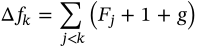
where  is gap. Frames after a file's last localization, recorded but empty, are not known to the table and are not counted.
A time attribute moves up by the summed durations of the files before. A file's duration is its frames,  , times its frame time. If its last time stamp is later than that, or the frame time is not known, the last time stamp is used instead, so the next file never starts inside this one. The frame time is the file's own, as the session recorded it, else the camera's.
Id attributes are the whole-number attributes whose name ends in _id. The numbers of file  (all but -1, "in none") move up by the sum of the highest id + 1 of each file before it. MINFLUX's trace id
tid is one too. Some id attributes stay as they are: roi_id, and the attributes written from regions' results (Regions to attribute). They are an ROI's number, which is the same whichever file a localization came from. An id attribute in which no two files share a number (file_ids.apart) is not moved at all: adding the files has already moved it (file_ids.keep_apart), with the same rule, and moving it again would only renumber what was measured per id.
The table's metadata (its camera, its fit) is the first file's. The new file entry keeps each original file's entry (combined_from). Its pixel size is the first file's. It has a frame time only if all the files share one, and its attributes are all the attributes any file had.
The files' camera frames are kept for the first file only. Its frames keep their numbers; the other files' frames would need theirs moved too. Layers that showed some of the files show all of them again.
| setting | default | what it does |
|---|---|---|
gapgap | 0 frames | Empty frames left between one file and the next. 0 makes the files one movie with no break. Set it to at least the merge setting's dark frames, so that grouping never joins the last frame of one file to the first frame of the next. Do this when the files were recorded with a pause between them, long enough for the fluorophores to change. 0 to 1e+06 frames |
The table, now one file, and a line saying how many files went into how many localizations and frames. Each incompatibility is a warning in the same line. "a.tif was read without z_nm: its rows hold padding there" means the file had no such attribute, so its rows hold NaN there, not a measurement.