 ; a longer one starts a new burst. In a region, that is all: the blinks of the region on one time line, cut at the long dark times.
Analysis › Measure · version 1 · can run once per region
On-times, dark times and blinks per molecule; per region, the blinks
Measures how the fluorophores blink: how long a blink lasts (the consecutive frames in which one fluorophore stays on), how long it stays dark before it comes back – its dark time, also called the off-time – and how many times one molecule blinks. These numbers decide how a dye should be imaged (how long a blink is, against the exposure), how the localizations of one molecule are merged, and whether the localizations in a cluster can be turned into a number of molecules.
It does two things, depending on where it runs:
Times are in frames and, with the file's frame time (the time from one frame to the next), in seconds.
It does not find the clusters to count in (Find clusters, Segment regions and Filter ROIs do), and does not fit the number of molecules to the counts.
1. Blinks. A blink is what the layer merges: on a layer that shows merged blinks, the localizations merged into one; on one that does not, a run of localizations in consecutive frames. It is on from its first frame to its last, so its on-time counts a frame the fit missed in the middle of it.
2. Dark times. The dark time before a blink is the number of frames between the end of the blink before it and its start. Two blinks that are on at the same time – two fluorophores in one region – have none between them.
3. Bursts. The blinks are joined wherever the dark time between two of them is at most the dark time ; a longer one starts a new burst. In a region, that is all: the blinks of the region on one time line, cut at the long dark times.
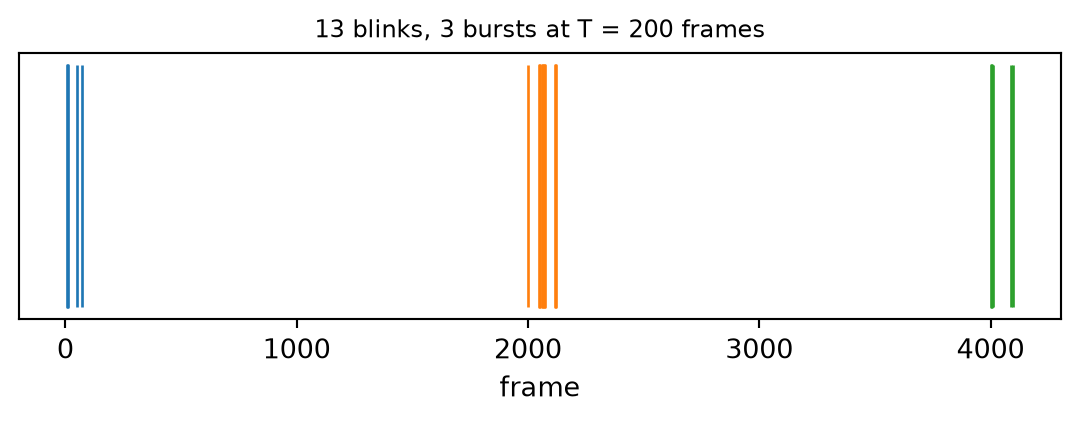
One region holding three molecules that came on at different times. Each bar is a blink; the gaps between them are dark times. With a dark time T of 200 frames the long gaps between the molecules split the blinks into three bursts (colours), and the short gaps within a molecule do not.
4. Molecules, on the view. On the view a field holds many molecules on at once, so time alone cannot tell them apart. The localizations are first linked into molecules by the same walk that merges blinks, but across up to  dark frames, within a box of within, per file and channel: a molecule is a blink merged with a long dark time. Within each molecule its blinks, the dark times between them and their number make the three histograms, one line per file.
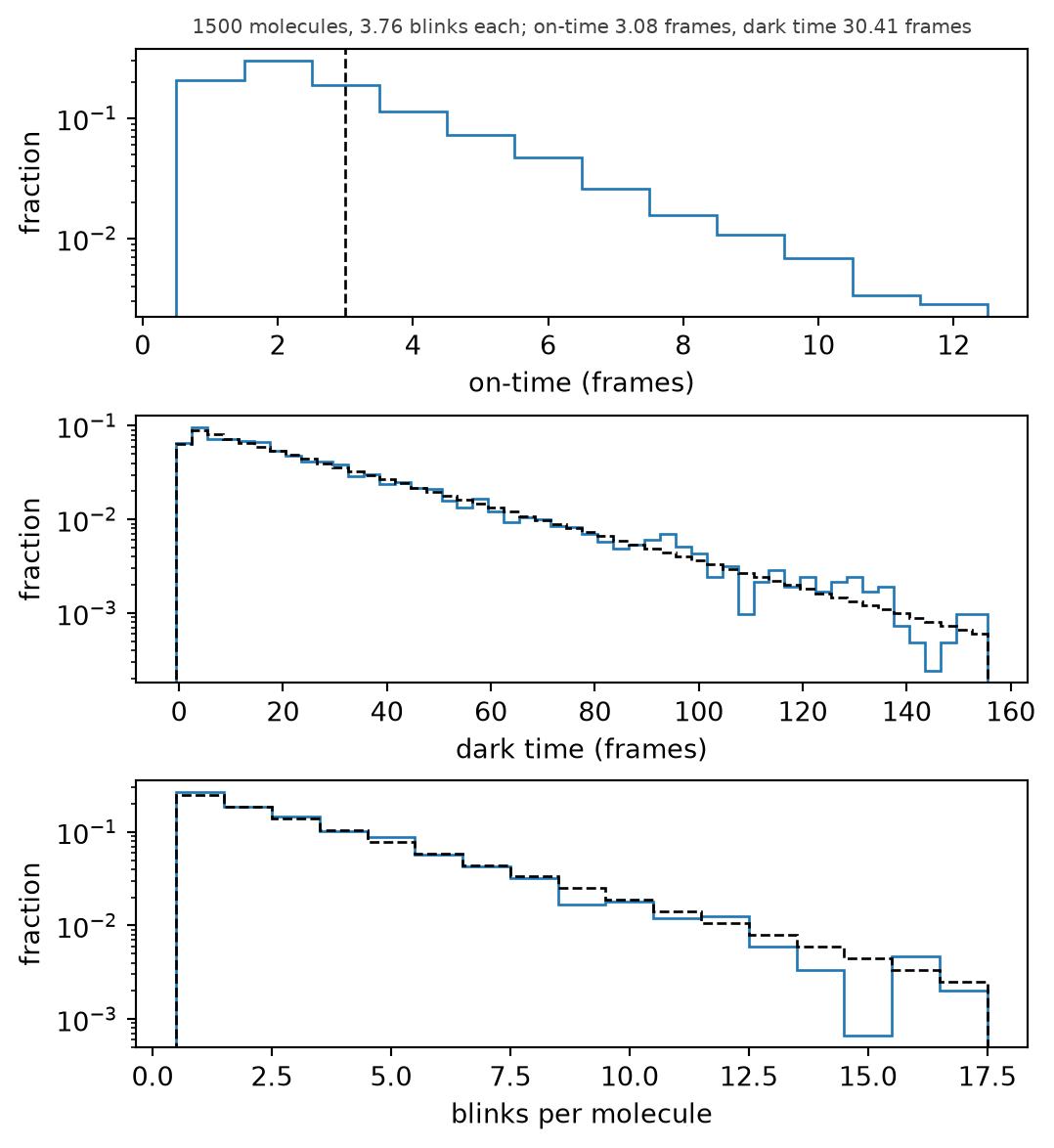
Simulated kinetics with an on-time of 2 frames, an off-time of 30 frames and a bleaching probability of 0.25 after each blink. Black is what those rates predict: a mean on-time of 3 frames (the frames a 2-frame blink touches), dark times one frame plus a geometric number with the off-time's decay, and a geometric number of blinks per molecule with mean 4.
Blinks. Without merged blinks the localizations of a molecule are sorted by frame, and a new blink starts wherever the frame number jumps by more than one. With them, a blink is the localizations that share a group_id; its first and last frame are their smallest and largest frame. Blinks are ordered by their first frame within each molecule.
Dark times. For blink  of a molecule, after blinks that ended at frames
 ,

with  its first frame: the frames in between, none of them on. A negative
 – the blink began before an earlier one had ended – is no dark time and is left out, as is the first blink of a molecule.
What the simulation predicts. An exponential on-time of mean  frames that begins anywhere within a frame touches
 frames on average. A dark time that leaves no frame wholly dark is not seen at all: the two blinks are one run. Past the first dark frame an exponential dark time starts afresh, so the dark frames seen are
 , with
 exponential of the same mean
 : on average
 frames. The blinks of a fluorophore that bleaches with probability
 after each one are geometric, of mean
 , less the few pairs too close to tell apart.
Bursts. Blink  starts a new burst when it is the first of its molecule or when
 . SMAP counts
 , which is a dark time of
 frames or more; here a dark time longer than
 splits, the same rule as the layer's dark frames when it merges blinks, so
 is the number of dark frames a burst bridges.
Molecules. The localizations are linked by group.connect, the walk that merges blinks, with a box of half-width within and  dark frames, separately per file and channel. The blinks within a molecule are found as in a region, with the molecule kept apart.
The view's numbers (the values of a run on the view) are the molecules': n_bursts is the number of molecules, n_blinks their blinks, and the means are over all of them. Per region there is no linking: the region is taken to be one structure.
Seconds. A time in frames times the frame time. The frame time is the file's (metadata["camera"]["frame_time_ms"], or the session's record of each file): the cycle time the file recorded where it recorded one, else the exposure, or what File > File properties set. With files of different frame times in one region, there is no one frame time and the seconds are NaN; set frame time to give one.
| setting | default | what it does |
|---|---|---|
dark timedark_time | 100 frames | The longest dark time within a molecule: longer starts a new burst (a region) or a new molecule (the view). Longer than the dye's own dark times, so that the blinks of one molecule stay together, and shorter than the time between two molecules coming on, so that two molecules are not one. The dark-time histogram of a sparse sample shows the dye's: take |
withindistance_nm | 50 nm | How far a molecule's localizations may lie apart to be linked (the view only). A few times the localization precision: wide enough for the scatter of one molecule's localizations, narrow enough that two molecules are not linked. On a dense sample the molecules overlap whatever it is set to, and the view's numbers mean little. at least 1 nm |
time intime_axis | frames | The unit of the on-time and dark-time axes. Choices: frames; seconds |
log scalelog_y | on | The fractions on a logarithmic axis. |
frame time (more)frame_time_ms | auto | Auto: the file's, else its exposure. at least 0.001 ms |
Per region, a row of the region table:
n_localizations – the localizations of the selected blinks in the region.n_blinks – the blinks, as the layer merges them.n_bursts – the bursts at the dark time: the molecules, if  is chosen well.
mean_on_frames, mean_on_s – the mean on-time of the blinks.mean_dark_frames, mean_dark_s – the mean dark time between blinks within a burst (dark times longer than  are between bursts and are not counted).
The seconds are NaN without a frame time.
On the view, the same numbers over the molecules, a line per file in the text (its molecules, their blinks, the mean on- and dark time in frames and seconds) and three histograms, each a line per file and each the fraction of that file's total. The on-times and the dark times of a dye with one on- and one off-rate fall in a straight line on the logarithmic axis; a bend in the dark times says there are two kinds of dark state, or that the dark time  is cutting the long ones off. Blinks per molecule much larger than the dye's means the molecules are too dense to be linked apart.
A port of the counting part of SMAP's Analyze/cluster/dyeblinking, and of the locsdf count of its counting plugins (Analyze/counting/private/cluster_mmaple_makehist.m) (Ries 2020). The main changes:
 ; here at a dark time of more than
 frames, which is
 .
 where it has fallen to nearly nothing. Too short counts a molecule several times; too long, on a dense sample, counts several molecules as one.