Analysis › DNA-PAINT · version 1 · can run once per region · can follow the ROI
A site's time trace and binding events: bright and dark times, the
In DNA-PAINT an imager strand in solution binds to a docking strand on the target and comes off again, so every site blinks again and again for the whole acquisition. How often a site is bound says how many docking strands it carries, and when it was bound says whether it is a good site at all. This plugin reads both from one site's time trace: the frames its localizations fall in.
It links the localizations of the site into binding events and measures
It runs once per region – an ROI of the ROI manager, or a cluster of an id attribute, as a per-region step or a chain's block – or on the view, where the selection (a drawn ROI round one site) is taken as one site. A region is one structure: its localizations are linked in time alone, whatever their positions, so draw the ROIs round single sites. The figure is the trace, which the ROI manager shows while Up and Down step through the ROIs; Space un-ticks a bad one.
It is not Time Course, which follows the whole field (medians over a hundred windows) to check an acquisition, nor Blinking, which describes a dye's blinks. The influx is calibrated, and the regions' kinetics pooled, by qPAINT.
1. Binding events. The localizations of the region (or its merged blinks) are joined wherever fewer than link gap + 1 frames separate them: one binding of an imager is one event, even if the fit missed a frame of it. An event's bright time runs from its first frame to its last, both counted.
2. Dark times. The dark time before an event is the number of frames from the end of the event before it to its start. Gaps of link gap frames or fewer were joined in step 1, so every dark time is longer.
3. Mean times and the qPAINT index. The mean dark time is a maximum likelihood estimate that also counts the dark frames before the first event and after the last (In detail); the qPAINT index is the rate of binding, about one over the mean dark time. A site with four docking strands is bound four times as often as one with one.
4. Sites. With an influx – the qPAINT index of one docking strand, calibrated on regions whose number is known – the sites of a region are its qPAINT index over the influx.
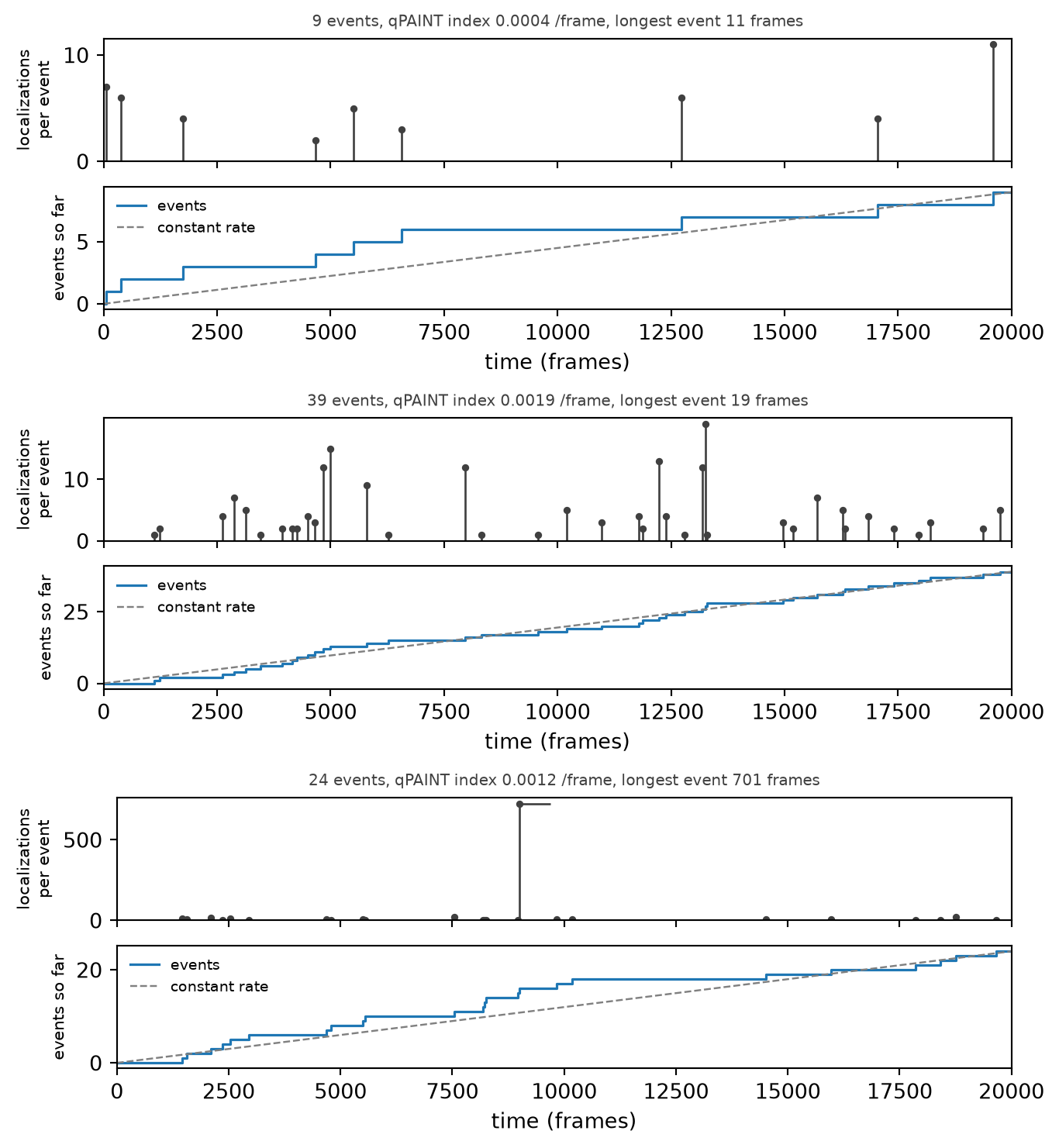
Traces of three simulated sites, each binding for 5 frames on average and each docking strand free for 1500 frames: one strand (top), four (middle), and two with a sticky imager held for 700 frames (bottom). Each stem is an event at its start, as high as its localizations; below, the events so far against the diagonal of a constant rate. The four-strand site climbs four times as steeply; the sticky one is a single tall stem and nothing in its cumulative count gives it away.
5. Curation. A good site binds at a constant rate from the first frame to the last, its events short. The values below each say how far a site is from that, so a condition such as longest_bright_frames < 50 & peak_window_fraction < 0.8 keeps the good ones.
Linking. The region's blinks (the layer's merged blinks, else runs of consecutive frames) are sorted by first frame and a new event starts where the dark time before a blink is longer than the link gap  ; per file, so two files' frames are never joined. This is Picasso's
link(..., r_max=999999, max_dark_time=3) for a pick. The dark time before event  is

with  its first frame and
 the last frames of the events before: Picasso's convention since its version 0.11.3, and Blinking's.
The mean dark time. For dark times exponential with mean  , a frame counted bright from half covered, an observed
 is longer than
 and only its excess over
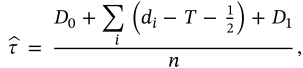
 is exponential. The dark frames before the first event (from the first frame of the acquisition) are a complete exponential dark time; those after the last event an incomplete one. The likelihood is then maximised by
with  and
 the dark frames before the first event and after the last, and
 the dark periods that ended – the events, one per file more than the dark times between them. Leaving
 and
 out, as a mean of the dark times between events does, makes
 short by about
 : by 9 % at ten events. Where the acquisition's frames are not known,
 and
 are left out and
 is the number of dark times between events.
The qPAINT index is the unbiased rate
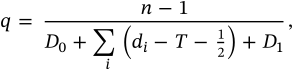
not  , which overestimates a rate by
 – 11 % at ten events. Its standard error is
 , so a site needs about 25 events for its count to be good to 20 %.
The acquisition. Its first and last frame are, in order: acquisition when set (frames 0 to acquisition - 1); the file's own number of frames, where it records one (a simulation does); the first and last localization of the file in the whole table.
The cumulative fit (estimator) is Picasso's: a least-squares fit of 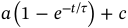 to the cumulative count of the sorted times,
 held between the shortest and the longest; the mean for two values or fewer. The free offset
 absorbs the link gap, but the ends of the acquisition are not counted, and on simulated single sites with ten events each the mean dark time came out about 20 % too short. It is offered to compare with Picasso.
The bright time is the mean of the events' bright times (the cumulative fit fits it as it fits the dark time). Two docking strands bound at once are one event, so a site of many strands has slightly long events.
Missed bindings. A binding shorter than about half a frame lights no frame and is not seen; its dark times on either side are seen as one. At a mean bright time of 5 frames that is about 10 % of them, and the index is that much low – for every site alike, so the calibrated influx carries it and the counts are not affected.
Curation values (Picasso's frame analysis rejects a cluster whose mean frame is outside 20 to 80 % of the acquisition, or that has more than 80 % of its localizations in one twentieth of it): mean_frame_rel, std_frame_rel (0.29 for a constant rate) and peak_window_fraction, each over the localizations, each frame as a fraction of its own file's acquisition. uniform_p is the p-value of a Kolmogorov-Smirnov test of the events' first frames against a constant rate.
| setting | default | what it does |
|---|---|---|
link gaplink_gap | 3 frames | Frames without a localization inside one binding event; a longer gap is a dark time. Picasso's default is 3 frames. Longer joins two bindings of a site with many strands into one; shorter splits a binding the fit missed a frame of. Keep it the same for calibration and sample. |
estimatorestimator | maximum likelihood | How the mean bright and dark times are found. maximum likelihood unless the numbers are to be compared with Picasso's. Choices: maximum likelihood; cumulative fit (Picasso) |
influxinflux | auto | Bindings per frame of one site, from qPAINT's calibration; empty: no site count. From qPAINT on regions of known site number, with the same link gap; it depends on the imager's concentration and the buffer, so calibrate it on every sample. |
time intime_axis | frames | The unit of the trace's time axis. Choices: frames; seconds |
windows (more)windows | 50 | Windows of the trace kept for Curves. at least 2 |
acquisition (more)frames | auto | Auto: the file's frames, else its first to last localization. Set it when the table's localizations do not reach the first or the last frame (a filter on frames, a merged file). at least 1 frames |
frame time (more)frame_time_ms | auto | Auto: the file's, else its exposure. at least 0.001 ms |
A row of the region table per region (and the values of a run on the view):
n_localizations, n_events, locs_per_event – the localizations, the binding events and the localizations in each.first_frame, last_frame, span_frames – of the localizations.longest_dark_frames, longest_bright_frames – the longest gap between events and the longest event: a sticky imager is an event hundreds of frames long.mean_bright_frames, mean_dark_frames – the plain means.tau_bright_frames, tau_dark_frames and in seconds tau_bright_s, tau_dark_s – by the estimator; NaN seconds without a frame time.qpaint_index, qpaint_index_err – the binding rate per frame and its error.n_sites, n_sites_err – the index over the influx; NaN without one.dark_total_frames, dark_periods – the numerator and denominator of the mean dark time, which qPAINT sums over regions.mean_frame_rel, std_frame_rel, peak_window_fraction, uniform_p – how evenly the localizations and events spread over the acquisition.The region keeps the trace in windows windows of the acquisition (frame, events, localizations and cumulative, the fraction of the events begun so far), which Curves averages over regions of one file, and each event's first frame, bright time and dark time. The figure is the trace: a good site's cumulative count follows the diagonal; a step is a sticky period, a bend a site lost or gained during the acquisition.